Editor's ChoiceCategories Credit Type Issuers Blog

Don’t Care How, I Want It Now

09/13/2008

Happy Weekend Everyone!

I was visiting Get Rich Slowly this weekend, and I watched a fun little video from 1948 on thrift habits and building a budget. It really started me thinking about how fast times are changing. All around us, the world that our grandparents knew has all but disappeared. Personally, I think that’s not all bad, but there sure are some real gems of wisdom that are next up on the extinction list.

Patience, I think would have to rank highest on this list. Today so many of us (and I regrettably include myself here) we just want things now. Save? Save? Why? I can just toss it on a credit card and get it now. See, this is where the trouble starts. Because as soon as we let that “now” impulse take over and convince us to charge too much we are committing to two things:

1) Being In Debt
2) Letting compound interest work for someone else, instead of us. That’s the same as having our money work for someone else, instead of us. Time is on their side now, not ours.

The true secret to credit cards is that they benefit you tremendously if you pay them off each month, and they benefit Visa, MasterCard, Discover, and American Express tremendously if you do not.

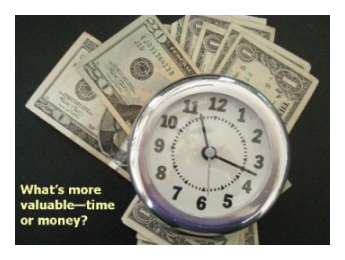
So how do we beat the “Now Monster?” Well, if I had that answer…. 🙂 What I can do though, is include a fun little visual representation. The next time I am tempted to put something on my credit card that I can’t pay off at the end of the month, I am going to focus on this instead:

One of my very favorite quotes goes something along the lines of “The secret to happiness is wanting what you have.”

In honor of that, here are some fresh new articles from around the blog-o-sphere. They each, in their own way, caused me to think about what is really “enough.” I do hope that you will enjoy them as much as I did.


When Is Enough “Enough?”


The Future’s So Bright I Gotta Wear…Night Vision Goggles??


Carnivals, Festivals and Celebrations:

Thanks to these carnivals who featured our posts this week:


That’s it for today. Sincerely wishing you enough.


Did you like this post? You can get our future articles for free! (Click Here)


Keep Reading:

Can Your Spouse Hurt Your Credit Score? The Good, The Bad, And The Ugly

09/12/2008

There are different ways that getting married, or divorced, can impact your credit score. Let’s take a quick look at some of the more common ways that your spouse can affect your credit:

The Good:
If you and your spouse go in together to get a home, car, or personal loan, then both of your credit scores will factor into the bank’s decision. In this case, your spouse’s score does affect the bank’s decision, but it does not actually affect your own score.

The best advice in this scenario is to have the person with the lower credit score take the time to raise their score before applying. If this is not possible then consider just having the person with the higher credit rating apply for the loan on their own.

You can also list each other as Authorized Users on your credit accounts. If you keep low balances, and make timely payments, then both of you get to have the advantage of boosting your credit through sharing your accounts.

The Bad:

Combining your credit accounts with your spouse does open you up to some risk if things in your marriage start to go sour.

Authorized user accounts are one example of a situation where your spouse can damage your credit score, and you can damage theirs.

When you list your spouse as an “Authorized User” you are assuming the responsibility for any charges they make on your credit card. If your spouse is angry with you, or you are going through a divorce, then the best thing to do is remove your spouse’s name from your credit accounts immediately. Otherwise you will have a legal obligation to repay whatever they charge. If they charge more than you can pay, or go over the limit, you are the one liable for the payments, not them.

The Ugly:

When Your Spouse Takes Off With Your Credit Cards:

If you are going through a messy divorce, or a heated argument, and your spouse has taken off with your credit cards, then you need to treat this as identity theft. If you do not, then you are liable for any charges that they make, and you do have to pay it back.

An un-authorized credit-happy spouse can not only cost you thousands of dollars, but they will cost you your good credit rating as well! If your cards are ever charged above 30% of their total limits you can expect your credit score to drop.

When Your Spouse Takes Off With Your Social Security Number:

It’s sad to say, but there are a whole lot of people out there who have had this happen. They get a divorce, and the next thing they know, they are being turned down for credit. What they did not realize is that their ex spouse used their personal information to open up credit accounts and get loans.

Again, this is identity theft. No matter how much you might want to care for, or protect the person, this is identity theft. You can either accept what they have done, and foot the bill, or you can report it as identity theft and press charges if you need to. There really are no other options.

Also, if you accept the theft of your information, and continue paying the bills for your spouse, your credit rating will suffer. This will not only cost you whatever amount of money they borrowed in your name, it will cost you thousands of dollars in additional interest on your future loans or mortgages because of your damaged credit rating.

Have a question for us? Leave a comment below!

Keep Reading:

In Case of Identity Theft, Check Your Criminal Records

09/10/2008

In our previous articles, we talked about what to do if your purse or wallet is stolen, and how to freeze your credit reports, how to check your credit reports for free – all the goodies. But what we have not yet covered is one last identity theft essential – checking your criminal records.

If you know, or even think that you may be a victim of identity theft, then you need to make a point of checking to see if your name has been used as an alias in a crime. Once a thief has your information, they can use it any way that want to – from making fraudulent charges, selling your identity to others, or even posing as you if they are arrested.

There are plenty of online services that you can use to check your criminal records. Unfortunately, most of them cost upwards of $40. In this case, the best thing that you can do to ensure your name has not been used to protect a criminal’s identity is to check your FBI records.

The following bit of information comes from the U.S. Department of State’s Criminal Records page:

FBI RECORDS CHECK: The Criminal Justice Information Services (CJIS) Division of the Federal Bureau of Investigation (FBI) centralizes criminal justice information and provides accurate and timely information and services to local, state, federal, and international law enforcement agencies, the private sector, academia, and other government agencies.

The subject of an identification record may obtain a copy thereof by submitting a written request to the CJIS. The request must be accompanied by satisfactory proof of identity (consisting of name, date and place of birth, and a set of roll-inked fingerprint impressions) and a certified check or money order for the $18 processing fee.

The FBI will not provide copies of arrest records to individuals other than the subject of the record. Requests should be directed to FBI CJIS Division, Attn: SCU, Mod. D-2, 1000 Custer Hollow Rd., Clarksburg, West Virginia 26306. If there is no criminal record, a report reflecting this fact is provided.

Identity theft is expensive, there is no way around it. But you can make the recovery from identity theft as painless as possibly by following the correct procedures to control and prevent further damage.

You need to call your bank, file a police report, freeze your credit reports, report the theft to your credit card companies, and do a criminal background check. That covers your bases and minimizes the damage the thief can do to you.

Have a question for us? Leave a comment below!

Did you like this article? You can get our future articles for free! (Click Here)

Keep Reading:

Will Creating A Repayment Plan With Your Credit Card Company Hurt Your Credit Score?

09/09/2008

One of our readers, CB, sent us this question:

I have a couple of credit cards that I have been 30 days past due on. This is just because I’m a little tight strap for cash right now. One of my options is to enter a prepayment plan with the credit card company, I am willing to do it but will this hurt my credit score? What effect that this have on my credit history? Please advise.

Hi CB, thanks for your question!

Creating a prepayment plan with your credit card company will not hurt your credit score at all. In fact, it’s the very best thing you can do in this situation. Just make sure that you stand by whatever agreement you make with them – to the letter. I say this because if you do not pay as agreed you can expect, at a minimum, to have your interest rates on the card raised, as well as incur additional penalties and fees. Your credit card company could also close your account.

The only things that show up on your credit score as far as your credit cards are concerned, are your limit, your available balance, and whether or not you pay late, or on time.

As long as you keep to the agreement, and keep making your payments on time, then your credit card company will not report you as being late, and your credit score will not suffer.

If you want to check and see how recent late payments may have affected your credit score then you can always use the recent TransUnion Class Action Settlement to take advantage of some free credit monitoring.

Just know that making a payment arrangement with your credit card company is the best thing you can do to protect your credit score right now.

Thanks again for your question!

Have a question for us? Leave a comment below!

Keep Reading:

Will Credit Counseling Hurt Your Credit Score?

09/08/2008

One of our readers, Sharon, sent us this question:

I am considering credit counseling services. Someone told me if I decided to go through with the program, it could impact my credit – making it worse than bankruptcy. Is this true? I’m having a hard time believing it is, but I’d like to get another opinion. Thanks

Dear Sharon,

Thanks for your question! There is not really a simple answer to this question, because it depends on the credit counseling service that you use. Just using a credit counseling service by itself will not hurt your credit score. Meaning that when you go, and sign up to have them help you manage your debt repayment, it will not show up on your credit score.

However, many credit counseling services can definitely damage your credit score as they attempt to negotiate your debt.

Here are the facts:

When I worked in collections for Providian Financial, we were allowed to negotiate settlements, balance reductions, remove interest, late fees, and over the limit charges. The normal customer service reps were not allowed to do this though.

What that means is that you usually have to be past due, and sometimes seriously past due on your credit cards to get many of these benefits. Credit counseling agencies know this, and it is a pretty common practice for them to hold the money you give them until you are seriously past due, and then negotiate a deal with your credit card companies.

So, yes, doing things that way will definitely hurt your credit score – sometimes more than a bankruptcy does. A bankruptcy is one incident as far as your credit score goes, and it is followed by an immediate reduction in what you owe. So while yes, bankruptcy hurts your credit score, months and months of late payments on several accounts can actually hurt it more.

Before you go to a credit counseling service, it never hurts to get all of your paperwork together, and contact the companies that you owe money to. Tell them you are considering credit counseling, or possibly bankruptcy. Ask them what they can do to help you.

All credit card companies have a policy for removing late fees, over the limit fees, accepting settlements, etc. If you take the time to find out what the policy is, and ask them to remove those fees, then you can probably handle the issue without a counseling service.

However, if you have a lot of accounts that have already been sold to collection companies, then you are probably better off just going to a credit counselor. They have a lot of experience in negotiating settlements with collection companies, and it will save you a lot of time and headaches.

Just be sure that whatever counseling agency you choose, that you understand their policy on debt repayment. Ask them if they plan to hold your money, and for how long? The last thing you need is to have months and months of bad marks going on your credit report while you are trying to do the right thing and resolve your debt.

Thanks for your question!

Have a question for us? Leave a comment below!

Did you enjoy this article? You can get our future articles for free! (Click here)

Keep Reading:

A Review of Rich Dad’s Guide to Investing: What the Rich Invest In That The Poor And Middle Class Do Not

09/07/2008

After I read and reviewed “Rich Dad, Poor Dad” last week, I was itching to check out “Rich Dad’s Guide To Investing.” I looked it up online and found it to be $30, which I thought was too much. So, I checked out our local bookstores, and found it for $19.99.
Happily, the clerk had an additional coupon he was able to scan for me, so I got the book for just under $15 dollars – a 50% savings. Which, as it turned out, was a nice metaphor for the book itself. I got about 50% of the value out of this book than I did from “Rich Dad, Poor Dad.“

Rich Dad’s Guide to Investing isn’t a bad book, by any means, it’s just that I’m not at a point yet where I can use many of his ideas. So, I cataloged them in my head, and stored them for later. There were four main points near the beginning of the book that I realized I could use and act on now though, and I would love to share those with you today.

Time is Not Money, Money is Time:

Growing up, I have always heard people say “Time is Money” and frankly, I’ve just never been able to swallow it.

Kiyosaki has a different take on things though, he believes that money is time. I am probably taking things a little out of context here, but the point was loud and clear.

If you need to get from LA to New York, you have plenty of options: You can drive, take the bus, or take a plane. Each method of travel involves a different amount of money. You could possibly take the bus for less money ($100 or so) while a flight could cost you as much as $500. Taking the bus could cost you several days of time, but you would save money. Taking the plane would save a lot of time, but it would cost more.

The idea, to me, was simple. When you have more money, you can take advantage of things that save you time. You can outsource, delegate, and generally afford to pay other people to take care of things that take up too much of your time. The more money you have, the more of your own time you can .

Unfortunately, health care works the same way. If you get seriously ill, and you can afford the best treatment, you can possibly yourself more time. If you cannot afford that treatment, or those medicines, then you lose time, and health. Please do not take this statement to mean that I am advocating government managed health care – I am not! I’d far rather have the option to get the best treatment I can afford, than be told what treatment I am going to get whether I like it or not.

This was a pretty new thought for me – the more money you have, the more of your own time you are able to control. That alone is a good enough reason to learn to be wealthy in my book.

Have A Financial Plan – In Fact, Have Three of Them:

Kiyosaki’s “Rich Dad” advised him to create not one but three financial plans.

1) One for comfort
2) One for security
3) One to be rich

His Rich dad told him in no uncertain terms to put the first two plans into action before attempting the third. This involves sitting down, concentrating, and deciding what the words “comfort”, “security” and “rich” mean to you. How much money do you need to be each of those things? What steps do you have to take?

Kiyosaki believes that most people (if they get this far at all) simply aim to be comfortable, or at best, secure. I have to admit that I’m at a point in my life where simply being comfortably wealthy, and secure would be an enormous blessing. I am with Kiyosaki on the third one though, I don’t just want to settle for the first two – but they are the right place to start.

Get A Financial Advisor:

Along with creating those three types of financial plans, Kiyosaki recommends hiring a financial advisor. This is something that I have put off doing for a while now. I’m a bootstrapper, I do things on my own, learn the hard way, and I’m suspicious of new things until I have worked through them and understand them. Even with all those negative traits, I am still going to take Kiyosaki’s advice. I am going to get my plans together, and hire a financial advisor. Why?

Because I don’t know how to manage my own money yet. I’m about as fresh off of the turnip truck as they come. Fresh out of bankruptcy. Fresh out of mismanaging our money so badly that when the medical bills started rolling in, my husband and I simply had no money to pay them. At the time, we made $30,000 dollars together, each working full time.

Things are a little different now. After the bankruptcy, we sought out education, second jobs, and a chance to give ourselves a fresh start. But, guess what happened? We worked like crazy, and still had no money saved. We had no money out there working to earn us more money, so that someday we might have more control over our own time.

Now that we are recovering from the bankruptcy, and ready to begin a new life, we are still working on our financial education. It will probably take us years to get to the point that some of you are already at. Frankly, I don’t want to waste that much time that could be spent investing. Yes, I am going to learn everything I can about finances and money management, and investing – but I’m not there yet.

So, the right thing for me to do is find someone who is there, and let them help me manage my money until I reach that point. Reading the passages in this book that deal with financial advisers really did help me to see that it’s time to go ahead and take that step so that I can focus on the bigger picture.

Teach Your Children To Manage Their Money:

Teaching your children about money is a recurring them in both “Rich Dad, Poor Dad”, and “Rich Dad’s Guide To Investing”.

Kiyosaki points out numerous times that the rich groom their children to manage their money when they are older. Poor and middle class people do not talk about money, especially with their children. He also points out that schools do not teach children to manage money, either. So if the parents are not teaching, and the schools are not teaching, then where are our children supposed to learn?

This is something that I really took to heart. I do not want my children to make the mistakes I did. For a long time I blamed the healthcare system for causing our bankruptcy. But you know what? It had nothing to do with it. Stuff happens.

We were managing our money so badly that if it hadn’t been medical bills, it would have been something else. I was the problem, and I can be the solution.

I think that Rich Dad’s Guide To Investing is a good book, and certainly one that I will continue to refer to and re-read as my own knowledge grows. I think that why I love Kiyosaki’s books so much is because he deals directly with the psychology behind being rich, and being poor.

Before anything can become a reality, we first have to change the way we think. We have to think, dream plan, learn, and practice new habits to truly become different than we are. Kiyosaki’s books do help me to do that, and they have rightfully earned a spot in my library.

As a final note, if you are looking for a book that is going to spell out a simple, concrete method of investing, this isn’t it. Instead it deals much more with how to think and behave, and it helps you create your own guidelines and habits based off of your unique goals.

Did you like this article? You can get our future updates for free! (Click Here)

Have a question for us? Leave a comment below!

Keep Reading:

Photo Credits: RichDad.com, iwanthealth.com, palmbeach.govoffice.com, more4kids.info, stealthsettings.com

If You Split Your Focus, Are You Doomed To Fail?

09/06/2008

Happy Saturday Everyone!

I’ve been thinking a lot lately about productivity and focus. Frankly, it seems like the less I focus, the less I produce. (That’s pretty well a given, right?) But what about splitting your focus? Is it possible to focus on many things at once and do them all well? Or, by splitting our focus, do we dilute our energy, time and power?

These are things I’ve wondered as I’ve watched Sarah Palin speak, and seen the gnashing of teeth around the blog-o-sphere – particularly from other women. Not everyone is out to chew her up and spit her out of course, but there have been some interesting questions raised.

How can she be VP and a mother? How can she meet the demanding needs of her youngest child, and our country? How can any mother for that matter? At the end of the day, in our hearts, can we truly say that splitting our focus between our family, and careers was successful?

I think some of us can, and some of us cannot. It’s a personal question, and we each live with those answers every day of our lives.

Can we really give the very best of ourselves to everything we do? What could we be if we achieved laser-tight focus on one goal? Would it be worth the loss of everything else?

If you have thoughts on this matter, I would love to hear them. It’s a sensitive topic, but one that I think is worth discussing.

In fact, the same could be said of our finances: Do you want to be debt free? Should you save for retirement while you do it, or just focus on your debt?

Should you massively diversify your investment portfolio and split the focus of your money? Or should you concentrate your money in the areas you think will bring the most profit?

Undeniably, you would expose yourself to risk by focusing your assets, but by spreading your money too thinly among many investments, don’t you risk losing your chance at the greatest profit?

With those thoughts in mind, I’d like to focus in on the most thought-provoking, inspiring articles that came out this week. Each one gave me something to ponder, and I hope that if you take the time to read some of them, that you will enjoy them too!

Introducing Steadfast Finances:

Matt at Steadfast Finances is a regular reader and commenter here at Ask Mr. CC, and he always has something insightful to contribute. After he left a couple of comments, I decided to go have a look at his site – I was not disappointed. He had a couple of articles that really stood out to me. He isn’t afraid to take an unpopular stance, and call a situation like he sees it.

To Be, or Not To Be?

To Buy, or Not To Buy?

Food for Thought:

Carnivals:
Many thanks to these carnivals for featuring our posts this week:

That’s it for this post! Wishing you a merry weekend full of focused, family, hobby or fun time!

Did you like this article? You can get our updates for free (Click Here)

Keep Reading:

Photo Credits: circusentertainers.co.uk, branaghcompendium.com, clean-energy-ideas.com

What You Need To Know About The TransUnion Class Action Settlement

09/05/2008

TransUnion is in some serious hot water. They violated the terms of the Fair Credit Reporting Act when they sold the personal information and records of consumers (us!) to businesses hoping to target people in a certain credit range.

They have reached a settlement agreement, and pretty much everyone is set to get something out of it.

Here’s the skinny:

If you carried a credit card, mortgage, student loan, or auto loan between the years of 1987 to May 28, 2008, then you are eligible to get something out of the settlement.

Here’s the settlement offer:


My personal take on this?

By themselves, your Transunion credit report and score mean very little. To get a full picture of your credit rating, at the very least you need to view your credit reports and scores from all three bureaus plus your FICO score. As far as the Mortgage simulator calculator, there are similar tools available for free online.

Personally, I’ll sign up for the cash settlement, and be happy if I receive it. However, if you have never monitored your credit report, and would like a free way to try it out, then it may be a good way for you to decide if credit monitoring is right for you.

You can register to take part in the settlement at the official site.

Did you enjoy this article? You can get our future updates for free! (Click here)


Keep Reading:

Photo Credit: programmers-progress.com

Should You Sign The Back of Your Credit Card?

09/04/2008

There is quite a heated debate going on right now about whether or not you should sign the back of your credit cards.

Some people are staunch advocates of leaving the signature panel on your credit cards blank, while others prefer to write “See ID” because they believe it deters theft.

Some consumers simply sign, and don’t worry about it.

Let’s take a quick look at the real facts of the matter:


      Well, per the terms and conditions of every major credit card company, if you do not sign the back of your credit card, then the card is not valid. If merchants accept a credit card that is not signed, then they could be liable for the charges if your credit card is used fraudulently. If a clerk notices that the back of your card is unsigned, they are supposed to make you sign it in front of them, and then ask for your id.

The problem with leaving your credit card’s signature panel blank: If your credit cards are ever stolen, the thief can simply put their own signature in on the back, and then the signatures will match perfectly.


If a store clerk actually checks the signature panel on your credit cards, they will ask you for your ID. This could possibly help prevent identity theft.


The problem with signing the back of your credit cards with “ask for ID”: Your card isn’t valid unless it’s signed, and merchants do not have to accept your credit card unless you sign it.


This is what Visa, MasterCard, American Express and Discover all say you should do. Your card is only valid once it’s signed. Signed card = smooth transactions.


The problem with signing the back of your credit card: If your card is ever stolen, then the would-be identity thief now has a nice example of your signature to copy. If they can get their signature to match yours very closely, then it can make it very hard for you to prove that you did not make the transaction.


This is probably the best option, since anyone who bothers to look at it might take the time to request your ID, or at least to check and see if the signatures match.


Why it doesn’t really matter one way or the other:

Have you detected the weak link here? It’s the store clerks. Nine out of ten clerks do not ever flip that card over to look at the signature panel. If they do, it’s very likely that they are new, not working during a busy time of day, or they’ve been ripped off before.

No use thinking those in-store digital signature panels actually compare your signature either – they don’t. The truth is, no one is out there checking the signature panel of our credit cards. I wish it wasn’t that way, but it is. For some really hilarious anecdotal evidence of this, I invite you to check out The Credit Card Prank I, and The Credit Card Prank II.

Now, I am very sure that there are some good hearted cashiers out there who will doubtless prove me wrong (“I check the back of everyone’s credit card”)

I know there are good cashiers are out there. Some of them do their job, and do it really well. But 90% of cashiers could care less if your card is signed, or if the signatures match..

The point I’m trying to get across is this: No one is watching over us, or our credit cards to protect us from fraud. As consumers, this is our responsibility. We need to check our credit reports regularly, look carefully at our credit card statements, and not rely on the overworked staff at SuperMart to protect our identities.

Sign, don’t sign. Doesn’t matter.

If you do want to get the best of both worlds, then go ahead and sign your card so that it’s valid, and also write “See ID”. If you really want to feel better about the situation, then check your free credit report once a year, and review your credit card statements each month. You could also consider subscribing to a cheap monthly credit monitoring service that will alert you to identity theft if it happens.

Have a question for us? Leave a comment below!

Did you like this article? You can get our future articles for free (Click Here)


Keep Reading:

Photo Credit: AOL.com

Binge Spending and Financial Fasting

09/03/2008

We’ve all been there. We get upset, and we eat a double cheeseburger, or a pint of ice cream.

We have an argument with our boss, or a co-worker, and our plan to quit smoking bites the dust.

We miss a flight and spend $50 in the airport gift shop. Or, in my case, I stop at Starbucks every morning out of habit, and because it is a small comfort.

What do all of these things have in common? They are ingrained, destructive behaviors.

We eat, we smoke, we gamble, we drink, or we spend; habitually, and during an emotional state. Then we feel guilty. Regretful even. We know we didn’t need that cheeseburger, or that new pair of shoes, or that new electronic toy. We know it broke the budget, and we vow to do better next time. But for how long?


Binge Spending:

“Binge Spending” is exactly what it sounds like. We get a little bit of money, and we gorge ourselves. We use that money as a salve, covering over an emotional wound. In the end we come out bloated, frustrated, and sick over our actions. If the money was spent on credit, we come out of the binge episode in debt, which creates another cycle of worry and stress the following month when the bill is due.

Sometimes people binge spend because they feel poor, and going out and ing whatever item is at the top of their list makes them feel better – for a little while. That is, until reason and guilt set in.

Reason and guilt inevitably give way to:

Financial Fasting:

Financial fasting is the other end of the spectrum. It’s where we mentally berate ourselves for spending money we didn’t have, and promise – will ourselves not to do it again. So, for a while we go without. We don’t eat out, we don’t clothes, electronics, 25 ¢ gum balls, nothing.

Then we start feeling restricted. And the cycle begins again.

Here’s where I ‘fess up: I just bought a new laptop, after my daughter broke my old one. Oh, but I didn’t just any laptop. I bought an $800 laptop. I thankfully did not put it on credit, but it did give a heck of a one-two punch to my bank account. There was a cheaper model. A much cheaper model. But I didn’t it. I bought the more expensive laptop for the following “reasons”:

By refusing to think logically about my habits and emotions, I let them control me.

So, here’s my question to you: What’s your advice? How do you fight this battle? How do you avoid financial temptation in your own life?

How can I fight the good fight, and grow wealthy, when I’m my own worst enemy?

Did you like this article? You can get our future articles for free. (Click here)

Keep Reading:

Privacy Policy Terms and Conditions About Me Disclosure Contact Me

Newsletter Sign Up

Name

Email