Editor's ChoiceCategories Credit Type Issuers Blog

Chargebacks

03/27/2009

Yesterday, I discussed the use of debit cards and how they compare to credit cards. I noted a key difference, the chargeback. With a debit card, you have to prove outright fraud in order to successfully charge back a purchase. Your card would have to be stolen or a merchant would have to make a completely unauthorized charge. With a credit card, you merely have to contend that the product or service was not delivered, and the presumption of guilt is on the merchant.

Today, I have two examples of how the chargeback is a huge advantage.

Inauguration Chaos

Last January, millions of people showed up in Washington for the inauguration of President Obama. Most received tickets for free, but some made a donation to the Presidential Inauguration Committee or PIC and received VIP tickets. While most attendees of the inaugural festivities had an incredibly good time, some were prevented from attending by the huge crowds and some epic security screw ups. In one case, a couple had paid $10,ooo to the inaugural committee, according to this article in the Washington Post, yet they were prevented from attending due to the security snafus.

In this case, their donation was charged to the couple’s American Express account, and they tried to get the money refunded after the event. For a while, it seemed like the committee was cooperating, but now they are giving them the cold shoulder. Their response is to request a chargeback from American Express. While $10,000 is a very large chargback, I think that they have a strong case. First, they are dealing with American Express, which has a better reputation for defending their customers in chargeback disputes than Visa or Mastercard. Next, they clearly did not receive the services that were promised. The worst case scenario is that the committee will claim that they did not get to attend due to circumstances outside the committee’s control, such as crowds or security. I think that is rather week, since the committee did have some control over security and crowds , and to a large extent, they just botched it. From the committee’s standpoint, I don’t think they have much of a case unless there was a clearly spelled out contract that was presented to the couple when they made their donation as to what their liability would be in this circumstance. The analogy would be when someone purchases tickets to a sporting event that is canceled due to weather. Usually the ticket has terms that clearly dictate what the holder is entitled to in that circumstance, such as tickets to the make up game, a refund, or a credit towards a future game.

I am sorry they missed out on this once in a lifetime event, but I hope they are able to take advantage of the protections inherent in all credit card purchases to recoop their money.

My Recent Chargeback Experience

Two weeks ago, I was skiing at Breckenridge Colorado with my parents. They generously offered to pay for my lift ticket. I presented my discount pass to the ticket window and explained that I would prefer not to use their “resort charge” option. This is a system where they link your pass to your credit card and charge it automatically. After some difficulty, they salesperson at the ticket office decided that she would have to print out a new pass for me, and then charge my lift ticket to my parents credit card. I was assured that my card would not be charged.

Of course, when I received my credit card statement yesterday, I was in fact charged the $59 for the lift ticket. I contacted my father, who happened to have the register receipt for the purchase, and I was able to submit a copy of that to American Express as part of the dispute process.

Unknown is how American Express will figure out that the receipt includes a lift ticket for me, and not three other people. Ultimately, the Breckenridge people should be able to look into their computer system’s records and verify that three of us skied that day and we were charged four times, since each skier has a unique pass with a picture on it. I have confidence that American Express will sort this out. At the very least, they immediately issued me a temporary credit for the $59, pending their investigation.

Congress Debates Credit Cards, and Credit Vs. Debit

03/25/2009

According to today’s Washington Post, Congress is currently considering new rules that will reign in credit card companies. The problem is that companies will enormously jack up interest rates in a predatory matter. Combine that with the new, horribly revised bankruptcy law of 2005, and you have recipe for credit card companies forcing people into bankruptcy. According to the article: “Under current law, people filing for chapters 7 and 13 bankruptcy protection are obligated to pay credit card balances along with secured debts, such as house and auto loans.” What’s even worse, is that credit card debt is actually prioritized above child support payments!

What Will This Proposed Law Do?

This bill would cap the interest rates at which credit card companies may charge consumers at 15% plus the current yield on the 30-year Treasury bond. That combined rate is currently 18.5% . Any banks that charge interest rates beyond that would not be eligible to recover that debt when a person declares bankruptcy. The intended effect would be to give consumers leverage in negotiating lower rates with their credit card companies. Currently, it is in a credit card company’s interest to raise rates as high as possible, especially when they do not feel that a card holder is able to pay their balance, such as when someone looses their job. In that way, they can rack up as much debt as possible before the person declares bankruptcy. In many cases, it becomes a self fulfilling prophecy as the higher rates force people into bankruptcy, and the courts protect the debt to the banks.

This bill would discourage banks from forcing people into bankruptcy, partially neutering the egregious 2005 bankruptcy act.

What Do The Banks Say?

The bank’s response to every possible change in the status quo, or failure to enact legislation that they favor is always the same. “If you don’t do what we want, we will have to restrict credit, and raise interest rates and fees. Ultimately the consumer will lose if you don’t do what we want.” They said this in regards to the proposed credit card bill of rights, and the eventual new rules.

Excuse me for being just a little bit skeptical that the credit card issuing banks have our best interest in mind. With the credit card companies, the sky is always falling. Frankly, I don’t think people are scared, as these companies already do everything they can to legally scam people, it is hard to imagine laws restraining them actually making it worse. As Senator Sheldon Whitehouse accurately noted: “The standard credit card agreement gives the lender the power to bleed their customer through evolving and ever more crafty tricks and traps, under this business model, the lender focuses on squeezing out as much revenue as possible in penalty rates and fees, pushing the customer closer and closer to the edge of bankruptcy.”

Credit Cards Vs. Debit Cards

The Consumerist today has a post about how banks are trying to get you to use your debit card like a credit card. According to the post, Chase in particular is pulling out all of the stops to get people to choose credit when offered the choice of credit or debit. Note, this is only when using a debit card. The result is always the same, that the money is taken out of your balance immediately, whether or not you choose credit or debit. The difference, from Chase’s perspective, is that they get much higher fees from signature authorized debit transactions.

In my research, I have found that some of their reward debit cards offer higher rewards for such “signature authorized” transactions. Take for example the Chase/Continental Airlines debit card. They offer 1 mile per dollar only on “qualifying transactions”. What qualifies? According to their web site:

“Qualifying purchases include all debit card purchases made without using a PIN. Such “non-PIN” purchases include purchases you sign for, Internet purchases, phone or mail-order purchases, [and] small dollar purchases that do not require a signature, bill payments.”

It is a good bet that these are exactly the types of transactions that cost the merchant higher fees. Lost in Consumerist’s blub are the key differences between debit and credit cards for those who pay off their balance in full:

1. With a credit card, I get a free float until my statement due date. I keep that in mind sometimes when I make a large purchase right after my statement closing date, giving me 50 days of free interest.

2. With a credit card, I get a host of protections, the most important of which is charge back power if a merchant doesn’t deliver. With a debit card, outright fraud is the only way you might get your money back.

3. Lots of perks. For an extreme example, see Mr. Credit Cards recent review of the vaunted American Express Platinum Card.

The real question is not whether choose debit or credit when using your debit card, it is why are you using it in the first place?

American Express Platinum Card Review

Update: Amex is in the midst of updating the features of this card. Some information on this page may be slightly outdated at this moment. We expect the new details today and will update when we get them.

About a year ago, I upgraded my American Express&#174 Preferred Rewards Gold Card to the American Express Platinum Card. I have held off writing a review because I wanted to have first hand experience with using the card. As time passes, I would like to share my experience with you. So here goes…

How I use the American Express Platinum Card?

This is going to be quite a long review because this card has simply lots of features. So I’ll start by actually telling you the key features that I make use of the Platinum Card&#174 from American Express. Most folks think that you need to be a super high spender to get this card. This could not be further from the truth. Here are some of the unique features that really makes this card worthwhile.

Borrow 60,000 Membership Reward Points – Have you ever wanted to take that dream vacation only to realize that you do not have enough points or miles? That may not be an issue if you have this card. If you are short of miles in your frequent flyer account, you can borrow points to top it up so you can get your free flight. Most frequent flyer program also offer bonus for miles transfer or purchases. Membership Rewards occasionally gives 25% to 50% bonuses for transferring points into air miles. When used correctly, this is a great way to get award tickets or business class upgrade.

Starwood Preferred Guest Gold Status – The very first thing you should do is to sign up for a Starwood Preferred Guest membership even if you do not have one. That is because if you tell Starwood that you have a Platinum Card, you will be given a Gold Elite Status as a SPG member. All you have to do is to get a “code” from Amex Platinum. You then all Starwood and mention the code. And once they enroll you, you will be given gold status.

Car Rental Memberships – The next thing you should do is to sign up for memberships in Hertz, National and Avis. The Hertz Gold membership is worth $60 a year. You enroll at www.americanexpress.com/premiumcarrental.

$200 Annual Airline Credit Fees – Each year, you acn be reimbursed for up to $200 when you use your card on airline incidental fees like in-flight food, baggage fees. You do however, have to pick a qualifying airline that you wish to earn these on (and you can only pick one). But if you fly a couple of carriers, just pick one and you could have that $200 in credit annually.

Lounge Access – Platinum cardholders are also given complimentary access to Priority Pass memberships. (Note: You must enroll in it). There are various tiers in their membership. The lowest tier requires a $199 annual fee and a $27 fee for each visit by yourself and a guest. The highest level has a $399 annual fee but free visits by yourself and a $27 fee for guest. With Amex Plat, you can visit Priority Pass Lounges for free though you have to pay a $27 fee for a guest. Enrollment can be done over the phone with Amex Platinum customer representative.

You also get access to Delta SkyClub Lounge. The Delta Skyclub membership fees ranges from $300 (if you are a Diamond Medallion member) to $450 (if you are just a silver member). So merely using these Lounges a couple of times a year pays off quite a bit of your Platinum annual fee.

As of 22nd March 2014, you can have access to Airspace Lounges in New York (JFK), Cleveland (CLE) and the Baltimore-Washington International (BWI) airports (learn more at airspacelounge.com)

Update: Presently, you are able access AA’s Admiral Lounge and US Airways lounge. However, from 3/22/2014, card Members will no longer be able to gain complimentary access to the American Airlines airport lounges (known as Admirals Club lounges) or the US Airways Club airport lounges as a benefit of their Platinum Card Membership.

On 30th September 2013, Platinum and Business Platinum card members could access Centurion Lounges. The current lounges are in the Las Vegas McCarran airport and the Dallas/Fort-Worth airport. The lounges are the first of several American Express airport lounges that will open in major U.S. cities, and offer complimentary gourmet food, signature cocktails and curated wines, high speed Wi-Fi, a computer bar, and more. For more information, visit thecenturionlounge.com.

Fine Hotels and Resorts – In my opinion, this is one of the most under-rated features of this card. Basically, Amex has teamed up with hotels in most regions in the US (and abroad as well). If you use your Amex Plat to book these hotels through Amex, you will receive a complimentary amenity and a room upgrade when available. For example, I stayed at the Fairmont Miramar at Santa Monica and got complimentary breakfast, a room upgrade and $100 in credit (which I used for a massage!). If you do use your card to book several stays at these hotel, you will realize how valuable the perks are.

No Foreign Transaction Fee – One of the nice features of this card is that there is no foreign transaction fees. And you’ll get to save that typical 3% fee when you travel abroad. Personally, I travel international once a year and this benefit is great because I do not have to get another card just to avoid this pesky fee.

There are other great perks which I have not used (like international business companion ticket). But using these benefits has made this card worth it for myself (in my opinion).

Now, let’s get on to the review itself where I will highlight the other perks not mentioned here.

Rewards and Formula

Membership Rewards First – The Platinum Cards reward is based on the Membership Rewards First program. “First” has slightly more rewards than the regular MR program.. You will earn one point for every eligible dollar that you spend and Membership Reward Points do not expire. (Watch the Video)

Travel Privileges

Platinum Travel Service – Platinum card holders can make use of Platinum Travel Service to make all their travel reservations. The advantage of using this service is that they will coordinate your bookings in terms of using the reward points you have earned.

Airport Club Lounge Access – already mentioned above.

Fine Hotels and Resorts – already mentioned above.

International Airline Program – The International Airline Program allows you save money on a companion ticket business or first class ticket when you purchase a full fair business class or first class ticket from Travel Platinum Service (using your platinum card off course). What essentially happens is that you do not have to pay for the base rate. But you do have to pay for other fees like airport taxes, fuel surcharges and a non-refundable $39 fee to Amex. Participating airlines include Aer Lingus, AeroMexico, Air France, Air NewZealand, Aitalia, Asiana Airlines, Austrian, Cathay Pacific, China Airlines, Delta Airlines, Emirates, Etihad Airways, Japan Airlines, Jet Airways, LAN Airlines, Luthansa, Mexicana, SAS, South African Airways, SWISS and Virgin.

Cruise Privileges Program – Platinum Cardholders who book their cruise vacations through the Platinum Travel Service with any of the cruise partners will get either a $300 shipboard credit or a two category stateroom upgrade. You will also receive additional amenities from each cruise line. Partners include Crystal Cruises, Cunard Line, Holland America Line, Princess Cruises, Regent Seven Seas Cruises, Silversea Cruises, The Yachts of SeaBourne, and Winstar Cruises.

Platinum Destination Vacation – American Express has also partnered up with select group of vacation partners that will allow you to earn points and use points for these vacations. For example include Abercombie & Kent, American Express Vacation&#174, AutoVenture, Brendan Worldwide Vacations, Classic Vacations, Insight Vacations, Mountain Park Travel Canada, Orient-Express Hotels, Trains and Cruises, PerryGolf, PrimeSport, Ski.com, Tauck World Discovery.

Premium Car Rental Program – see above.

Gold Starwood Preferred Guest Membership – see above

International Communications Solutions – This perk allows you to get the YouToMe Service where you can do call forwarding from your cell phone or you can give your friends a toll-free number to call you. Card members will be given 15 minutes of air time without any charge. I have not used this service, so I cannot say if it is good or not.

The Limousine Program – Amex has partnered up with Carey, a limousine company to provide limousine services. The perk is that you can earn two extra points for every dollar (that means three points – two extra plus the regular point per dollar) that you spend on the card.

Platinum Villas – As a platinum card member, you can get access of villas. Amex has teamed up with Abercombie & Kent, Beautiful Places, Four Seasons Residence Club, Lacure, The Mansion at MGM Grand and Villas of Distinction to offer highly acclaimed villas for your vacation.

Private Yacht Program – Amex has partnered with Fraser Yacht and International Yacht Collection to offer card members customized Yacht trips to various destinations worldwide!

Private Jet Service Program – Amex actually markets this service for private jet programs. Their partners include Atlantic Aviation Flight Services, Bombardier Flexjet, Delta AirElite Business Jets, Le Bas International, Sentient Jet Membership.

Travelers Check and Foreign Currency – Amex allows you to get travelers checks at any of their world wide travel offices. You do not have to pay any fees for this.

American Express Travel Website – Amex has actually their own travel website where you can book your trips. You can earn double membership points when you use the site to book your trips.

Platinum Concierge – Platinum card holders can have access to Amex Concierge service. This is a service that I have used many times, including the one that I made reservations for this years valentine’s day!

By Invitation Only – As a platinum cardholder, you may be able to get access to certain very high profile events. For 2009, these events include :

  • “Best of Both Worlds” Wine Dinner at The French Laundry
  • “Imported from Italy” at Italian Wine Merchants
  • 2009 Tribeca Film Festival
  • 2009 US Open Championship
  • 2009 Wimbledon Championships
  • 27th Annual FOOD AND WINE Classic at Aspen
  • 9 to 5: The Musical on Broadway
  • Cooking Sous Vide with Chef Thomas Keller
  • Cooking at Home with Chef Charlie Trotter
  • Guigal Wine Dinner at SHO Shaun Hergatt
  • Innovative cooking with Thomas Keller
  • Legends of Boston Baseball
  • Los Angeles Basketball VIP Experience
  • Mid-Century Style and Design with Jonathan Adler
  • Mother’s Day Delight with Tory Burch
  • VIP Exclusive at StageCoach Festival
  • Platinum Dining Reservations – Amex Platinum has made arrangements with participating restaurants, bars, bistros etc to hold a couple of tables for last minute reservations. I have many friends who have made last minute reservations at extremely hard to get restaurants. Now, they did not get the seats with nice views, but they did get a place.

    Platinum Shopping Partners – Amex has partnered by Neiman Marcus, Sony and Bergdorf Goodman to offer card holders certain privileges. For example, Platinum Card members can enroll their card in Neiman Marcus InCircle Program. You can then earn both InCircle Points and Membership Reward points when you shop at Neiman Marcus. Once you have accumulated 10,000 points, you can exchange them for a $100 InCircle gift card. Being enrolled in the InCircle program also allows you to earn InCircle points at Bergdorf Goodman as well. As for Sony, being a platinum card member allows you to enjoy VIP status with Sony’s program.

    Premium Seats Program – Platinum card members can also get access to tickets before the general public for events in L.A. and New York. Examples of venues include Madison Square Garden, Radio City Music Hall.

    Premium Access – Card members can also get early access and preferred seating (before the general public) to events like concerts etc.

    Departure Magazine – A few times a year, you will get a “Departure” magazine from Amex. This magazine has articles on various places and travel articles around the world. It also has some interesting write ups on things like antique, where to exotic stuff etc.

    American Express Selects – This is a program where you can shop at various online sites like hotels.com or orbitz.com (through Amex site) and get special discount using your Platinum Card.

    Premium Protection – Amex calls these “premium protection”, but (in my opinion) they really standard and common in most Visa and Mastercards these days. But here is a laundry list of features found on the Platinum card (that is found in most other Amex cards as well).

    Premium Global Assist – This is a 24/7 hotline service that you can call for emergency medical, legal service especially if you are in a different country. (I haven’t had to use this yet!)

    Roadside Assistance – I once had to use this when I left my keys in the car!

    Car Rental Loss and Damage Insurance – This feature is common among most credit cards.

    Baggage Insurance – When you buy an airline ticket with your Platinum Card, American Express will insure you for the “covered trip” of up to $3,000 for the replacement cost of both carry ons and checked in baggages.

    Travel Insurance – Most credit cards have this feature and it is activated when you book your travels with the card. For the Platinum card, the limit is $500,000.

    Purchase – This feature may protect you from damages, loss of goods you with the Amex Platinum for up to 10,000 per occurance and up to $50,000 in claims a year. I’ve had broken goods before, but the stores always took them back and I’ve never had to use this feature.

    Event Ticket Protection Plan – This feature protects you in the event that you bought tickets with Amex and cannot attend the events. You can be reimbursed up to $2,000 per incident for up to two incidents in a twelve month period. It needs to be a legitimate reason like medical reason for example. The “qualifying reasons” are not stated on the website so you will have to call their toll-free number to find out more. New York state residents do not qualify for this feature.

    Guaranteed Fraud Protection – On their website, Amex will guarantee you against any fraudulant charges to your account.

    Identity Theft Assistance – Amex has a 24/7 hotline for you to call in case your identity has been stolen. It has happened to me so I cannot comment on this service.

    Dispute Resolution – This should be a standard feature for all credit cards. But essentially, when you dispute a charge, Amex will try to reverse it and if it can’t in the instant, they will help you dispute it on your behalf with the merchant.

    Emergency Card Replacement – Amex will replace your card anywhere worldwide as quickly as 24 hours. Years ago, I was traveling in Australia and I lost a Visa card. I did not get a replacement card until I got home! It is moments like these that you wish you had an Amex!

    No Pre-set Spending Limit – No pre-set limit does not mean unlimited credit limits. But from my experience, I have never been called by Amex even if I have a spike in my spending for the month. When I’m about to put a huge ticket on the card, a phone call to customer service does the trick and I’ve always had no problems. This feature I believe will increasingly become more important as credit card companies indiscriminately cut credit lines.

    Phew – So What’s The Verdict? – Before I get to that, let me explain why I got this card. Firstly, American Express has been constantly sending me mails to upgrade my gold card. I got it partly for the ego of having one, but to also use it so I could actually review the card. How could I call myself Mr Credit Card and review a $450 annual fee card if I did not have one!

    Throughout my 15 years relationship with American Express, I have always had nothing to say but good words about them. Service has been great. Now, I do understand not everyone has a great experience with them.

    In 2008, the Amex Platinum still had the Domestic Companion Feature ( one get one free) which they have discontinued. I used the Domestic Companion Complimentary Ticket three times. I have used their Roadside Assistance, their concierge numerous times, got into airport lounge on a few occasions. So even without the domestic companion ticket, I think this card is worth the value.

    While reviewing the card again and writing this review, I realized that I have under utilized in several ways.

    I have not enrolled in InCircle! Should do that just in case Mrs Credit Card goes on a shopping spree in Neiman Marcus!

    I have also not used American Express Selects and get discounts shopping online!

    So rather than say whether this is a good card or if you wonder whether the $450 fee is worth paying, the question to ask is will you make it worth your while to get this card. After thinking long and hard about it, my answer is yes – it has for me and I think it will be worth it to keep this card going forward. Because there are so many features in this card, I have found that just using a few of them over the years have made this card so worth it for me. Recently, just booking hotels that are part of the Fine Resort and Hotels a few times a year has paid off for me. So has joining the Hertz Gold membership. I also use airport lounges whenever I fly.

    This card will appeal to various groups of people. For example, a frequent traveler will find this card appealing because of flexibility of Membership Rewards frequent flyer partners and hotel partners. Using airport lounges without having to pay for entry and getting various room upgrades at hotels are very valuable perks.

    A business person in an industry where client entertainment is so important may find this card very useful indeed if getting great seat for concerts etc is important.

    If you are in an industry customer service and image is important, then in my opinion, you might want to consider getting this card. Just to give an example : Last year, I sat down with two financial advisers over lunch at a diner. One took out a “gold” credit card to pay. But my keen eye told me it was a First Premier Bank Gold Card – a sub-prime card! The other financial adviser took out a “platinum card”. It turned out to be also First Premier Bank’s Platinum sub-prime card! Look, I never moved my accounts over to them. I’m Mr Credit Card and I don’t hand over money to a financial adviser who does not have good credit scores!

    So round up this long review, I absolutely love my Platinum Card&#174 from American Express. For me, the features more than make this card worthwhile and the service (for me at least) has been great.

    Schwab Credit Card Review

    03/23/2009

    Update 3/31/2010 – Schwab has pulled the plug on this card. But read on to find out how I’ve made more than 2% just on one card – and find out which card it is.

    schwabcreditcardIn an effort to lure and attract more new accounts, Schwab has recently come up with a cash rebate credit card where your rebates are automatically debited into your dSchwab account. So how does this card stack up? Let’s take a look.

    Rebate Formula – The Schwab credit card pays a 2% cash rebate for every dollar that you spend on the card. You can earn unlimited rebates. The rebates that you earn are automatically deposited into your schwab account at the end of every month.

    Eligible Accounts – To actually get the 2% rebates. You need an eligible Schwab account. If you do not open a Schwab account, you will still accumulate rebates which Schwab will hold for 5 years. Eligible accounts include Individual, joint, or trust (living and revocable) Schwab One accounts are eligible to be linked to your Schwab Bank Invest First card to receive cash rewards. Ineligible accounts include: Schwab One organization accounts for corporations, limited liability corporations, non-incorporated associations, partnerships, investment clubs, DBA operations, nonprofits and charities, as well as general brokerage accounts, IRAs, and other retirement accounts.

    Fees – There is no annual fee for this card. The APR is 13.74% and there is a 2.99% balance transfer offer for 6 months. Bear in mind that like most other cards these days, there is a 3% balance transfer fee charge, with a $10 minimum and no caps on the fee. The Schwab credit card also has the honor of being one of the rare credit cards which charges no foreign transaction fee.

    Other Benefits – The Schwab credit card comes in either the Visa Signature version or the Platinum version. The Visa Signature card has additional benefits such as no preset spending limit,1 Visa Signature Dining and Visa Signature Access. To receive a Schwab Bank Invest First Visa Signature card, you must qualify for a credit line of $5,000 or more. If you are approved for a credit line less than $5,000, you will automatically be offered the Schwab Bank Invest First Platinum Plus Visa card.

    Verdict – So here’s my verdict. 2% cash rebates is a great offer from Schwab. It is certainly better than most generic 1% cash back cards out there. But before you jump onto the bandwagon, make sure you have an eligible account because without one, your rebates cannot be deposited. For those looking to open a new Schwab, this card might just do the trick for you.

    But is 2% the best for everyone? Not really. It depends on how much you spend? What you actually use your card for? My main cash back credit card has been the Blue Cash from American Express. Over the last few years, I’ve averaged about 2.3% in annual rebates. The reason why this is possible is that I could earn 5% on gas, supermarket and drugstore spending after I cross the spending tier and for me, it has made me more than 2% (better schwab). Plus I do not have to open an account with them. I have screen shots of the rebates I earn in a review I did of the Blue Cash.

    Estate Tax Exemptions Question

    This is a question related to a very old post I did about estate exemptions and joint accounts. So, I will give a stab at it, but in future, we’ll probably keep the Q&As within the confines of the credit world. I also do not think myself or anyone here is qualified to answer this, but hopefully this will open our readers’ eyes into more complicated financial matters that does not get mainstream press coverage. So here goes :

    Question from Donna Freeman – Here is my question… my dad’s planning and Will had specifically allowed two rental properties to be the “remainder” (not specifically given to his wife)of his estate. The remainder is to go into the Trust that was set up prior to his death. The trust allows that the income is to be used by his wife (principal if needed). The catch for me is that the appraisals of the two properties came in at about $800k. He lives in NJ which has a $675k exemption cap.

    How do we report (form 706)and title the two properties so that $675k worth of the value is in the trust and the other $175k counts toward the marital unlimited exemption?

    Answers – First a disclaimer – we are not attorneys, so please do not take this as legal advice! Consult with your estate attorney. Having got that out of the way, here goes.

    The Economic Growth and Tax Relief Reconciliation Act of 2001 (EGTRRA), signed by President Bush on June 7, 2001. It provides for increases in the federal estate tax exemption. The present “federal” estate tax exemptions are

    $3.5mm for 2009
    No Estate Tax for 2010
    $1mm for 2011

    From 2012 onwards, the uncertainty persists and it is still to be ratified by Congress. Note that for anyone fortunate enough (pun intended) to die in 2010, there will be no estate taxes, but the cost basis of properties inherited will be at cost and not the value on date of death.

    However, many states like New Jersey have imposed their own estate taxes separately because EGTRRA has phased out the state death tax credit (which means states can no longer rely on a steady stream of income of estate taxes). So even if Donna’s dad’s estate if not subject to federal taxes, it “may” to subject to NJ’s taxes depending on how the estate is distributed.

    Our thoughts are that there are a couple of ways to look at it. Firstly, one property could be put into a trust and the other just given to his wife. Because of unlimited marital deduction, there should be no state taxes in this case.

    But presumably, there is a reason for him to put it in a trust, perhaps to ensure kids from first marriage will inherit it after his wife’s death (is this a second marriage?) or to sure that the money is managed properly. That being the case, we do not have answer for how to actually file the 706 form for New Jersey. I do not think it is even possible.

    Perhaps another consideration would be to sell one property. That should solve the problem. But that decision will be a function of (among many things) the cost basis of the property. If the cost basis is very low, it probably does not make sense.

    You also did not mention his other assets (stocks, cash in bank etc), which would materially affect his estate planning.

    Lastly, properties should be titled properly to be put into a trust – no joint accounts.

    As mentioned earlier, it is best to consult a competent estate attorney in NJ. Better pay a few hundred bucks to potential save on tens of thousands in estate taxes.

    Disclaimer again! – We not not attorneys so please do not take this as legal advice.

    Financial Peace Revisited by Dave Ramsey – Book Review Conclusion

    03/22/2009

    financial-peaceEvery week here at Ask Mr. Credit Card.com I review a personal finance book. This week I continue the review of “Financial Peace Revisited” by Dave Ramsey. If you missed the beginning of the review, you can read it here.

    Chapter Four: Understand The Spiritual Aspects of Money

    Ramsey offers a lot of good, common sense advice on how to be debt free, but these passages from Chapter four really hit home with me. I believe they contain some wisdom that will not only help us all to grow wealthier, but also to attain true success in anything that we work for:

    The author of this passage is unknown, but the advice is pretty timeless.

    I am your constant companion,
    I am your greatest helper or your heaviest burden.
    I will push you onward or drag your down to failure.
    I am at your command.
    Half of the tasks that you do you might just as well
    turn over to me and I will do them quickly and correctly.

    I am easily managed,
    you must merely be firm with me.
    Show me exactly how you want something done;
    after a few lessons I will do it automatically.
    I am the servant of all great people and
    alas of all failures as well.
    Those who are great I have made great,
    those who are failures I have made failures.

    I am not a machine, but I work with all the precision
    of a machine, plus the intelligence of a person.
    Now, you may run me for profit or
    you may run me for ruin.
    It makes no difference to me.
    Take me, train me, be firm with me,
    and I will lay the world at your feet.
    Be easy with me and I will destroy you.

    Who am I? I am called Habit.

    You know, the older I get the more I realize that habits literally “make you” or “break you.” If there is something lacking in your life, whether it is money, or time, or literally anything at all, take a close look at your habits.

    The truth is, human beings are completely creatures of habits. And there is not always a distinction made between time-wasting or negative habits, and positive, productive habits. This really is some of the best advice I have seen in a book in a long time, personal finance related or not.

    I think it’s the reason why so many New Year’s resolutions fail too – we create the goal but not the plan, and then we do not work at it long enough to make the plan a habit. Once things are a habit, they happen even when you don’t consciously think about them. It’s an “auto-pilot”.

    How much wealthier would we all be if we sat down, and decided what we needed to do to fix our finances, and then worked hard – really hard – until those things became a habit?

    One thing we often don’t recognize is that over time, those small negative habits really add up.

    Smoking is a negative habit, overeating is a negative habit. Change the habit and you will drastically change your body’s state of health. The same happens when we continuously overspend or take on too much credit. It becomes a habit to “just charge something and pay it later” and before we know it, we are deep in debt.

    In the case of my bankruptcy, “dealing with the medical bills later” became a habit. It even became such a pronounced habit that bankruptcy seemed like a real relief by the time I finally filed. No more worrying about the looming debt! If I had taken a proactive approach, done more negotiation, and raised my income, I could have avoided the pain of bankruptcy.

    If I had known that I just needed to establish new habits, and have a little self control, then that entire process would have been much less painful. It sounds stupid, I know, but that is the deceptively simple power of habit.

    Combining Habit With Education:

    When you combine regular changes in habit with regular doses of knowledge, you can spring forward quickly. If you want to lose weight, you can combine the habit of eating right with the knowledge of what eating “right” actually is.

    When you want to invest, you can combine the habit of investing with the knowledge of how investments really work.

    It really does take both – the learned habits, and the applied knowledge.

    Don’t sell yourself short. If you have any sort of a goal, please make sure that you include both parts of the “secret formula”. Learn what you need to learn, work to make it a habit.

    That’s when things will begin to look effortless. And if you’ve really got the formula down, you may begin to hear people say things like “Wow, they are so lucky!!!

    But, you will know, success was never based on luck. It comes from habit, and applied knowledge.

    This concludes my review of Financial Peace Revisited. Most of the advice in this book is very common sense, very basic. But it is presented in a friendly manner, and it’s an entertaining read. If you want to read the entire book, you can check it out from your local library, or a cheap used copy off of Amazon for under $5. It definitely gets my vote. Basic as it is, it’s thought provoking, and I’ll be keeping it in my financial library.

    Have you read this book? What did you think of it? Leave me a comment below!

    Keep Reading:

    What’s the best way to raise your credit score?

    03/17/2009

    What’s the best way to raise your credit score when you have had a few delinquent accounts?

    A reader, April, had this question:

    I used to have good credit but when I purchased my home my score went down some, even though I was on time.

    Recently I was having a hard time paying my home loan because my husband’s business was not doing well enough to be able to pay the mortgage. (He pays, though I am the only person on the loan).

    So we fell behind. However, we recently qualified for a loan modification. The only way we could get them to help us was to be delinquent on the mortgage.

    Now my credit score is in the mid 500’s…all of my other credit cards are on time, though they all raised the interest rate on me.

    So my only option to go back to my original low rate is to opt out (forced to close cards).

    In about a year we will be debt free with all closed credit cards… I want to start working on my credit score.

    Will my lender reverse the delinquent on my credit now that it is added to the new loan?

    Also will getting a secured loan/credit card now, even though I have good credit card history, help bring up my score?

    April

    Hi April. Thanks for your question. I think I can give you a plan of action that will help you raise your credit score and manage your debt a little easier.

    Here it is, in 5 steps:

    Step 1:

    Call the bank you have your mortgage through. Ask them if there is any way that they can reverse the late payment records on your credit report.

    Request it as a one-time thing, for a customer that has always worked to make arrangements with them. If you can get that from them in writing, even better. See if they can fax anything to you that is on official letterhead.

    You can also ask them to put a note in your account if they will not reverse the late notices. The note should look something like this:

    Made a verbal agreement with customer. She plans to challenge the late notices on her credit reports. Do not validate the late payments. Agreement with customer is to remove these items from her credit report.

    Obviously, that’s not a sure-fire method because your late accounts may be reviewed by computers and not by people, but it never hurts to ask the customer service rep to put it in there.

    Step 2:

    Repeat step one with all of your credit card companies. Have them remove anything that they are willing to from your credit report.

    This will be aggravating. But even one removal will raise your credit score, so it is worth doing.

    While you have them on the phone, please make sure you ask them to lower your interest rate, and remove any late or over the limits fees on your card. You can request that they remove up to a year’s worth of fees.

    Some companies will only remove one such fee, while other companies really will remove a year’s worth of fees as long as you still have a balance on your credit card.

    You can find out more about how to negotiate those deals here:

    Step 3:

    Pull copies of all three of your credit reports. Since you are actively trying to repair your credit score, then it makes sense for you to pick up a cheap credit monitoring service. Let me stress that using a credit monitoring service is more convenient, but not absolutely essential. If you want to save the money, you can, and I’ll explain why.

    Start by going to Annual Credit Report.com Make sure that you obtain a current copy of each credit report from TransUnion, Equifax and Experian.

    This is free. Make sure that you print a copy of each report. Look over each of the reports carefully.

    Highlight any negative information that you would like to have removed.

    You will then need to log on and begin the process of disputing the negative items on your credit report.

    This is time consuming, but in many cases it can dramatically raise your credit score. There are some standard “do’s” and “dont’s” though, so please check out our free guide before you begin disputing.

    According to the FCRA (Fair Credit Reporting Act) your lenders have 30 days to verify whether or not your claim is true. If they do not report back to the credit bureaus, then by law the delinquency must be removed from your credit report entirely.

    That is why I suggested that any customer service reps that you speak to should note your accounts that way.

    If you can get letters from your creditors saying that they do not dispute your claims, then you can send those to the credit bureaus as proof.

    It’s really just how much time and effort you want to put into it. The more you work to clean up your credit report, the higher your score will be.

    Step 4: Keep Checking Your Credit Report

    You are entitled to a free copy of your credit report when you dispute things on it. After 30 days, you should receive something in the mail from the credit bureaus telling you whether the late notes will be removed or not. If they were not removed you can keep challenging.

    If they were removed, then you will want to wait a month, and pull all three of your credit reports again. Make sure that everything that was supposed to be removed actually did get removed.

    Credit monitoring services that let you see all three of your credit reports are around $15 a month. This is convenient because you can log into one place and view everything, but as I said, in your case not strictly necessary since you can pull your reports for free after each challenge.

    Step 5: Check your FICO Score and Get New Credit

    If you choose to go the secured credit card route, yes it should help you, and you can get started right away, no need to wait until after you clean up your credit report.

    Just make sure that you never charge more than about $35-40 a month on that secured card, and set up an auto-pay so that you are never late. If you do those two things, then getting a secured credit card will help to raise your credit score.

    There is no need to check your FICO score when you apply for a secured credit card.

    However, before you apply for an unsecured credit card, make sure that you know your FICO score.

    If you aren’t yet in the 600’s at least, then just stick with the secured credit card, and keep paying off your loans as quickly as possible.

    Once you’re in the mid 600’s, you can consider balance transferring some of your high-interest debt. (That’s if you haven’t already paid if off first!).

    Thanks again for your question, and good luck as you work to raise your credit score!

    Have a question for us? Leave a comment below!

    Keep Reading and Grab our Free RSS Feed:

    Financial Peace Revisited By Dave Ramsey Part 2

    03/16/2009

    financial-peaceEvery week here at Ask Mr. Credit Card.com I review a personal finance book. This week I continue the review of “Financial Peace Revisited” by Dave Ramsey. If you missed last week’s review, you can read it here.

    Chapter Three: The Basics (a Foundation)

    Ramsey begins this chapter with a reflection:

    As a culture we are ignorant of what money is and how to handle it. Ignorance is not lack of intelligence; it is lack of knowledge on a particular subject.

    If I were put in a chemistry lab, I would probably blow up something. But I am not unintelligent. I am ignorant of Chemistry.

    It is almost impossible to get out of high school today without knowing what an amoeba is – now there is a really valuable piece of information – but few high school seniors can keep a checkbook balanced.

    They are taught virtually nothing about the real world of money. I am not talking about Wall Street. I am talking about money on your street.

    We are not taught basic principles of managing and making financial decisions for our own family.

    I do agree with his conclusions here. Not everyone is taught how to manage money. The schools do not teach money management because it is the parent’s job to teach it.

    After my bankruptcy I swore to myself that I would teach my kids how to manage money. If I don’t teach them, then life will. I didn’t learn my lesson until I hit bankruptcy. I’d like my kids to learn it a lot earlier than that.

    Ramsey goes on to discuss the consequences of a lack of financial intelligence.

    We come out of high school or even college and set up housekeeping. We don’t have knowledge of leases, but we sign one.

    We don’t have knowledge of cars and car financing, but we one and sign the loan papers. We don’t have knowledge of the implications of credit cards and high interest rates, but we get five pre-approved cards in the first two years out of school and we use them.

    We don’t know about the Rule of 78s or prepayment penalties, so we finance our waterbeds, stereos, TV’s, washers and dryers. It was all so innocent and happened so slowly that the monster in the closet was not noticeable.

    Well, I’d say the situation has definitely gone from an unseen “monster in the closet” to an elephant in the room. The credit crunch is definitely on.

    It’s become so normal to now and pay later that many, many people are in trouble. I know, I did it too. I even carried a balance on my new credit cards for a while after my bankruptcy. Something that I know now is the last thing in the world I should have done, (or ever do) financially.

    Ramsey’s right, it really is education. Once I learned what compound interest was, and how long it really takes me to pay off a credit card, well, impulse spending was a lot less attractive.

    I (slowly) learned that how well I managed my money was directly affected my my degree of financial education. The more I learn, the more money I have and the easier it is to hang on to it. It really does matter.

    Money Is Active

    I have found that money has two properties that most people don’t acknowledge or understand.

    First, Money is active. Finance and money are always moving. Time, interest rates, amounts, cash flows, inflation, and risk all intermingle to create a current that is ever flowing.

    Whether you choose to impact the current is irrelevant, they still go on.

    If you took $10,000 and buried it in the back yard for ten years, will it as much when you dig it up as it does now? Obviously not. We must learn that the current or flow of the mathematical process is always effecting our money. It never stops.

    Money in this sense is like a beautiful thoroughbred horse – very powerful and always in action, but unless this horse is trained when very young, it will be an out of control and dangerous animal when it grows to maturity.

    The point is this: You must gain control over your money or the lack of it will forever control you.

    If you don’t take action continually on your money, it, or the lack of it will take action on you. Finance is not passive, it requires you to take the imitative to control it.

    In his popular book, The Seven Habits of Highly Effective People, Dr. Stephen Covey says the number-one habit of highly effective people is that they are “pro-active”. They “happen” to things, things don’t happen to them.

    That is extraordinary advice, isn’t it? To stop letting life pass us by? To gain control of our situations, whatever they are, and be pro=active about them.

    Money Is Amoral – No Morals

    Second, money is amoral. Money has no morals. That is, it is neiter good nor bad. First Timothy 6:10 does not say, “Money is the root of all evil.” What is does say is, “The love of money is the root of all evil.”

    Money in and of itself has no more moral quality than a brick. So just because you are poor does not mean that you are good, or spiritually superior; neither does it mean that you are bad or spiritually inferior.

    You decide what you are. The way you act through your money or your lack of it, will show us whether you are good or evil, but the money itself is neither.

    Well, I do suppose a look at our bank statements would say a whole lot about our priorities in life. One of the things that I had to do when I continually found that I was poor, was to take a hard look at what my priorities were.

    Blowing money left and right indicates a skewed sense of the world and a total disregard for the future. Once I sat down and thought about my real priorities (having money in savings, investing for the future, being able to retire one day, etc.) my spending habits changed drastically.

    I think Ramsey is hitting the important points here. People that manage their money well were either taught how to do it, or they sought out the knowledge on their own.

    Growing your wealth and managing your family’s finances is a learning experience, not an innate ability. One thing that I do like about Financial Peace is that it does start with the common-sense beginnings of money management. I don’t feel stupid reading them, It feels a bit like talking to an older, wiser relative. He has a comfortable and congenial style.

    Please come back for a visit next week when I review the next chapter of Financial Peace. If you’ve read it, and it made a difference to you, please leave a comment below.

    I’d also like to send out a big thank you to the carnivals that featured our article this week:

    Non Amex Cash Back Alternatives

    03/13/2009

    Another couple cash back credit card questions today.

    Question from Guss Schippers: Re the BlueCash card from American Express: maybe you should emphasize that “supermarkets” do not include places like Costco, Wal*Mart, etc.

    Also I wonder whether you get the rebate on insurance premiums, like healthcare,
    etc., or internet purchases from people like Amazon, in fact anything you on the
    internet.

    Answers – Guss – you are correct, supermarket excludes so called “discount warehouses” like Costco’s or BJs. Thanks for pointing that out. I will modify my reviews to reflect that.

    You do get rebates on things like insurance premiums if you use the card to pay. You will earn the rate for “other purchases”. For everything you on the internet, it is considered “other purchases” and you earn 1.5% after exceeding the $6,500 annual spending threshold.

    If you want to earn extra rebates shopping in the internet, then the card to get is actually the Discover More Card. They have a program called shopdiscover.com where they have over 100 online retail partners. If you to their website through Discover, you can earn anywhere between 5% and 20% cash back bonus or rather discounts. Watch video below.


    Question from Fawn Gonick – what is the best cas back that is not american express card do you recommend ? I already own the starwood and blue cash amex card. They are both great cards, and can never decide which amex to use. ( that’s another story) But a lot of places do not accept amex. I had the Chase Feedom (Dynamic Cash Rewards) like you use to recommend but since your review in jan 2009 , you state that they are no longer doing the 3% on your top spending, it’s just an average card. Do you have another recommendation for non amex cash back card? I’d like to narrow down my credit cards. I always pay on time. great credit . Please tell me which ones you would use, and which you would get rid of. , and of course which new cash back non amex card to get. thanks in advance. Love your site by the way.

    fawn gonick

    Answers – As a supplement to the Blue Cash, I would actually recommend the Discover More Card. One again, like the answer above, Discover has partners with over 100 online retailers and you will earn anywhere between 5% and 20% cash back bonus (which to me is the same as getting a discount). Watch the video above

    The other alternative is the Citi Cash Returns card, which though only gives you a 1% rebate, has a feature called Citi Cash Bonus Center that is similar to Discover’s shopdiscover.com. Aside from online retailers, you can earn extra rebates when you use the card at off-line partners, their catalogs, their gift cards and their online stores. The rebate is about between 1% and 6% though Citi claims the average rebate is 5% (which I doubt). I’ve made a video on the Citi Cash Returns Review Page comparing the Citi Bonus Cash Center and ShopDiscover.

    Citi Cash Returns Card Review

    Update – Citi is no longer offering this card. Instead, this has been replaced by the Citi&#174 Dividend Platinum Select&#174 Card.

    Citi CashReturns® CardThe Citi CashReturns® Card is the latest line up of Citi’s cash back credit card and has a great shopping portal (where you can earn extra rebates) and it also offers a very generous 0% APR* balance transfer deal. Let’s find out more about this card.
    Rebate Formula – Well, unlike the Citi Dividend Card, the Citi Cash Returns Card offers 1% rebates for every dollar that you spend on the card. You can earn unlimited rebates that do not expire. Once you have earned $50, Citi will send you a check automatically. You will also earn rebates from cash advances and convenience checks. Given the interest charged on these, I suggest you avoid this trap. You will also earn 5 citidollars (as they call their rewards) for every $1,500 in balance transfers!

    As an incentive, new cardholders earn 2% rebates on every purchases for six months.

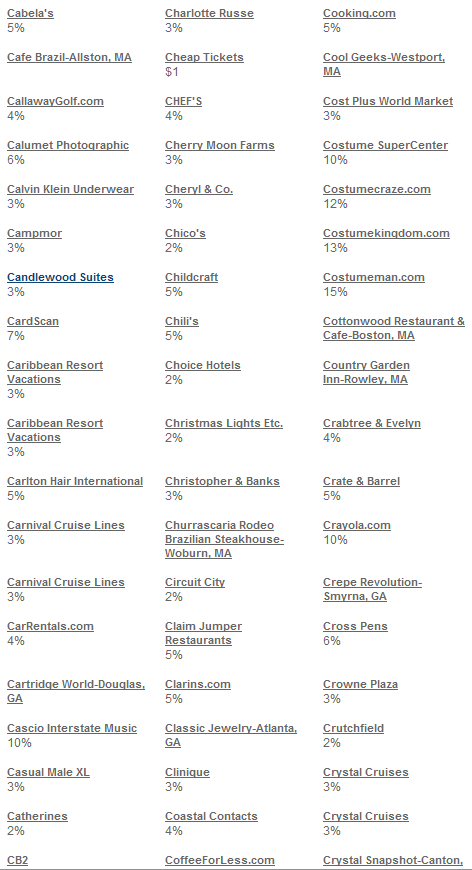
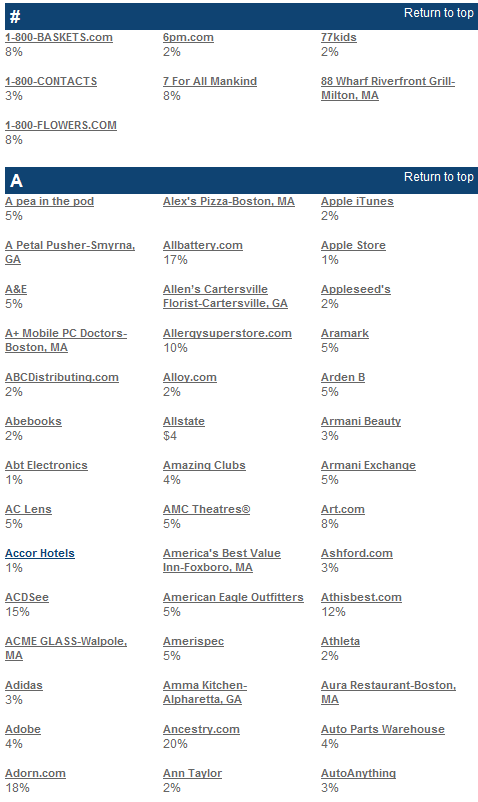
    Citi Bonus Cash Center – Citi has a feature called the “Citi Bonus Cash Center”, which has partnerships with about 400 merchant partners. The program allows you to earn extra cash rebates if you use the Citi Cash Returns Card to shop either off-line, online, through catalogs or gift cards with these merchant partners. (see screen shots below)

    Fees – The Citi Cash Returns MasterCard has no annual fee. New cardholders get a 0% APR balance transfer for 18, 12 or 7 months.

    Verdict – The Citi CashReturns® Card is a great card for various reasons. Firstly, they have a very good shopping portal where you can get discounts when you shop with their merchant partners (both online or offline). Secondly, if you are looking to do a balance transfer, this card offers a 0% APR* on balance transfers for up to 18, 12 or 7 months. I also like the fact that they send you a $50 check once you have earned that rebate (for those of us who are forgetful!).

    Citi Bonus Cash Center Online Merchant Partners

    Privacy Policy Terms and Conditions About Me Disclosure Contact Me

    Newsletter Sign Up

    Name

    Email