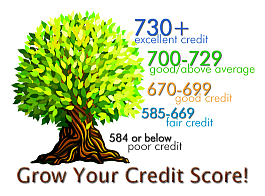
Editor's ChoiceCategories Credit Type Issuers Blog

Which Credit Monitoring Service Should I Use?

09/02/2008

When it comes to credit monitoring services, there are a lot of options available – and they are not all created equal!

One of our readers, Stacey, sent us this question:

I am thinking of joining Identity Guard or something else to help monitor my accounts and to tell me what my score is. Is it worth it?

Thanks for your question Stacey!

Credit monitoring services are a valuable tool. They help you monitor your credit reports and keep them free from errors, help you prevent identity theft, and allow you to track your credit score. Whether or not they are worth the ongoing expense will depend on your situation.

Most credit monitoring services run about $15 a month and up depending on what you sign up for. Credit monitoring services charge extra for things like tracking your credit scores, and how many of the three credit bureaus you want to view reports and scores from. That said, there are certainly times that you will probably want to track your credit scores and reports no matter what:

It is important to understand that all three of the credit bureaus have their own system for computing your credit score, and that those scores are separate from your FICO score. Before you agree to pay monthly for a credit score, be sure that you are paying for the scores that you want to see. Credit card lenders will usually check your credit scores at one (or more) of the three credit bureaus. Anything bigger than that (house, car, bank loan) and they will most likely check your FICO score instead.

Some credit monitoring services will show you your FICO score, and some will not. Read those terms and conditions carefully.

As for which credit monitoring service I recommend:

In the past I have faithfully used TrueCredit, Transunion’s credit monitoring service. However recently I have switched to Id Patrol from Equifax, and I am much happier with it. Here’s the lowdown:

Transunion (True Credit):


Id Patrol (Equifax), on the other hand has some really neat perks:

With all of those extras, plus the easy to read format, I switched to Id Patrol. I am very, very happy with it. I do recommend it for anyone who wants to monitor their credit, because they have more features in the same price point as all of the other credit monitoring services.

Thanks for your question!

Have a question for us? Leave a comment below!

Was this article helpful to you? You can get our future articles for free. (Click here)

Keep Reading:

Photo Credit: Dreamstime.com

Rich Dad, Poor Dad: Revolutionizing Personal Finance

08/31/2008

I think it’s safe to say that reading this book has forever changed my view of money and personal finance. I refused to read it for a long time because I’d heard a lot of negative things about it’s author, Robert Kiyosaki. Namely, that there was no “real” rich dad, or poor dad. I’m glad that I did finally read it though, because I learned so much that it’s going to be difficult to fit it all into one review.

You see, I spend a lot of time reading personal finance blogs. The big ones, the small ones, the in-between and bite sized ones. I always do my best to absorb, and walk away with something that will help me manage my money, and be a little better off at the end of the day.

It’s funny; when I finally got ahold of something that did make an impact, it was like finding a shiny new nickel in the middle of a bunch of lead slugs! No offense to my fellow pf writers is intended here. It’s hard to write truly revolutionary articles day in and day out, we do the best we can.

It’s just that I see a whole lot of articles focusing on how to spend less, cut back, or how to do without. In other words: how to be frugal. After reading Rich Dad, Poor Dad, I now understand that being frugal is not at all the same as acquiring and building wealth. Being frugal and managing your money are two different things as well. Living within a frugal mindset can actually help to keep you poor. To paraphrase a line from the book here;

Do not think “I can’t afford it.” Instead think “How can I afford it?” The one is an admission of failure, the other, a challenge.

We are constantly bombarded with articles about why we should not spend $6 on a cup of coffee, and how to live on a shoestring budget. Well, let me tell you that I am tired of living on next to nothing. I’m tired of eating beans and rice, and doing everything I can to be frugal. Because you know what? It’s not working. For all the doing without, I’m not a penny better off.

I want those six dollar coffees. I want a nice car that I don’t have to worry about breaking down when I take my child to school. I want more than I have, and I don’t think that’s such a bad thing. That’s what we read all these articles for, isn’t it? We want an answer, a way to make things better. I did find that answer in this book, and I hope you will too.

The Rich Don’t Work For Money – They Have Money Work For Them

In his book, Kiyosaki recounts his first job. His rich dad paid him ten cents an hour to take cans off of store shelves, dust them, and put them back. The young Kiyosaki quickly grew angry with the situation. It was mindless work, and he was paid a pitiful wage. When he took his complaints to his rich dad, he told him this:

He also goes on to say that most people allow life to push them around, and instead of learning from it, they get angry. Angry with their boss, for not paying them enough, angry with their spouse, angry with everyone but themselves.

His advice? “If you realize that you’re the problem, then you can change yourself, learn something, and grow wiser.

It is easy to blame someone – anyone else for our money problems. Just like it’s easy to sit back and expect to collect a pension, or a social security check, or even a welfare check. But if we never take responsibility for our own financial problems, then we never really have control of our own lives. It will be necessary for us to go to work every day, mindlessly doing what we have to do to get our next paycheck – which will almost certainly not be enough to meet our needs.

Pay Yourself First

Pay yourself first is a concept that I have seen many times around the personal finance blog-o-sphere. Nearly everyone, it seems, agrees that you should pay yourself first, but they don’t have too many suggestions as to what you should do with the money that you pay yourself. Me? My first inclination is to go a new TV, or an iPod. I’m not really getting ahead that way though, am I?

Kiyosaki puts it better:

The “rat race” as he defines it, goes something like this: Go to work. Get paid. Pay bills, food, possibly save a little. Buy on credit, pay it back, rinse, repeat.

Breaking out of the rat race: Go to work. Get paid. Invest money. Pay bills. Rinse, repeat; until you no longer have to go to work unless you want to, because your investments are paying your bills.

Now this isn’t a revolutionary idea, but it is certainly one that I have never been taught. I was told to go to school, study hard, get a good job, work hard, save money. Nowhere in that picture was investing even mentioned.

Even to this day, my parents do not invest in the stock market (other than through employer controlled and sponsored retirement accounts.). When I asked them why they said, “We just don’t have the money right now.”

Never mind that with the economy down it’s been like dollar days at the stock market. They aren’t investing in themselves first. They don’t own any income generating real estate. They have no money coming in every month that they did not have to work a 9-5 job for, and neither do I. But I can tell you this, after reading this book I am certainly going to figure out a way to make that happen.

I wish that I could tell you that this book lays bare the complete path to wealth – but it doesn’t. What it does do is challenge every basic assumption that I have ever had about money and how to manage it. I think that I have finally reached a point in my life where I am adult enough to look at my finances and say, “Hey, this isn’t working. I’m no better off from one week to the next, and it’s going to be that way forever unless I change things.

Kiyosaki does have other books that look like they go into much more detail on how to acquire wealth, but it all starts with Rich Dad, Poor Dad. This book is the one that taught me a new way of thinking about money, work, and building wealth.

I am very excited to read his other books soon, and I will review them here for you. Rich Dad, Poor Dad is a book that I will keep for years. I will read it, and re-read it until it’s message has completely sunk in for me. I will keep it around to turn to when I need a reminder about what my motivations should be, versus how I am living my life.

If you are at a point in your life where you have realized that what you are doing is not working, then Rich Dad, Poor dad might be able to help you make some sense out of things too. It is certainly different, and more straightforward than a lot of the information out there.

If you have read Rich Dad, Poor Dad (and it’s a #1 New York Times Best Seller, so I know you’re out there!) please leave me a comment and tell me what you thought. Did he challenge the way you thought about money and wealth? Did you learn anything you did not already know? Have you managed to break free of the rat race? Leave me a comment and tell me about it!

Did you like this article? You can get our future posts for free! (Click here)

Keep Reading:

Photo Credits: WyldSuccess.com, Estropiart.com

Saturday Link Love: New Computer Edition

08/30/2008

Well, I did it: I bit the bullet and got a new computer after accidentally destroying my other one last week. The first thing I did (after the first two hours of requesting forgotten passwords and setting up my email) was to surf around and check out all the articles I missed this week while I was wire-less.

Here are some of the very best ones I found, I hope you enjoy them!

First, congratulations are in order for Prime Time Money – he was selected as a top five contestant in the FNBO Direct Pay Yourself First Challenge. Way to go! Paying yourself first is a really important thing.

The more I learn about money, the more I realize that you really do have to pay yourself first and not blow the money. It should probably be called “Invest in yourself first!” This is something I am going to talk about a little more tomorrow when we do a review of “Rich Dad, Poor Dad.”

The money comes in…and it rolls right back out!

Choosing not to invest in your retirement accounts may not be something you regret right now, but it’s one of those things like getting a tattoo – it will stay with you forever and you’re really going to regret it later! Here are a couple of articles that I thought summed things up nicely:

Credit where credit is due:

The more I learn about managing my credit, the more interesting it becomes! There were some worthy articles to mention this week:

Make the best of it:

Times are tough. I’ve recently come to the understanding that if we never learn to manage our money, times will always be tough. Here are a few articles that might make money (or the lack of it) easier to manage:

Festivals, Carnivals and Celebrations:

Thanks to the Carnival of 20 Something Finances for featuring our article this week at Living Almost Large!

That’s it for this week’s link love edition. Wishing you a hard drive with a limitless amount of space, a long weekend that never ends, and 0% interest for life! Have a nice holiday. 🙂

Did you like this article? You can get our future posts for free. (Click here)

Do You Lie to Your Spouse About Your Credit Cards?

08/29/2008

We have a family member who constantly lies to her husband about her credit cards.

He thinks they have a great credit rating because he occasionally takes out “Six months same as cash” deals on furniture or electronics.

I know that they have a great credit rating because she has six credit cards that she’s had for years, and always makes the payments on time.

I dread the conversations where he advises me “All you have to do is take out a few six months same as cash loans, and then pay them off – it worked for us!” Inwardly I groan. We’re repairing our credit after bankruptcy, which is a serious ordeal. I don’t think a few six-months-same-as-cash loans (which we qualify for in our dreams) is going to fix anything for us.

So, I grit my teeth and cry a little inside. Not just because I know better, but because realizing their true situation makes me a party to the lie…

Yes, paying off those loans probably helped them, but it’s the wheeling and dealing going on behind his back that makes up most of their score. So I was thinking about it, and I wondered, “Is this normal?

I mean, in our pre-bankruptcy days, I’ll admit that I occasionally made purchases and did not inform my spouse of the amount, but I was the one that handled the money.

So, does my family member who’s hiding her cards feel the same way? She handles the money, so there’s no harm done?

After we declared bankruptcy my husband and I made a promise to be honest with each other, and to both try to handle the money together so that we really could have a fresh start.

So far, I’ve kept my promise. I don’t put much money on my credit cards, but when I do, my husband knows about it. I don’t give him the amount to the penny, but I do say “It was about $60” or whatever.

I think this policy has actually helped our marriage, and we have better control over our money than ever before. I can’t help but wonder though, are we the exception? Are you honest with your significant other about your debt? What about when you first met?

After I spent some time thinking about this, I surfed around a little online, to see what I could find. I came up with a few excellent articles that I wanted to share with you – in case you were interested too:

So, how about you? Have you ever told a “white lie” to your spouse about money? Do you know of family members who lie to each other about credit card debt? Are you ever caught in the middle? Tell us about it in the comments section below – It’s fine to be anonymous.

Keep Reading:

Photo Credit: CommittedMarriage.com

92,000 People at Risk for Identity Theft Thanks to IFMG

08/28/2008

Dominion Enterprises, the parent company of the InterActive Financial Management Group released a statement this month saying that it’s computer servers had been targeted, hacked and otherwise violated – revealing the personal credit information of 92,000 of it’s customers.

Their servers were accessed multiple times between November of 2007 and February of 2008 before the theft was discovered. The information that was stolen included the names, birth dates, social security numbers and addresses.

Dominion has promised to mail letters to consumers that they know were affected. However, I would be very cautious, if you have ever done business with them in the past – even if you don’t get a letter!

Dominion and IFMG are also offering a year of free credit monitoring services to customer’s whose information was stolen.

Dominion Enterprise’s President and CEO Conrad M. Hall Released this statement:

“We deeply regret this incident and apologize for the concern and inconvenience it has caused. We are committed to helping those who were affected and strongly encourage them to sign up for the complimentary credit monitoring and to take the action steps outlined in our letter.”

If you think your information may have been stolen, you can contact Dominion here:

Dominion Enterprises
Jennifer Butsch
Public Relations Manager
757-351-7951
jennifer.butsch@dominionenterprises.com

Have a question for us? Leave a comment below!

You can get our future articles for free when you click here.

Keep Reading:

Photo Credit: Dreamstime.com

Will Raising Your Credit Limit Hurt Your Score?

08/27/2008

One of our readers, Kali, sent us this question:
I was wondering how asking my credit card company to increase my credit limit will affect my score. I would like to take advantage of a 0% promotion. thanks – km

Hi Kali, thanks for your question.

Getting a credit limit increase will not hurt your score. In fact, it may actually raise it because it will lower your debt-to-credit ratio. Your debt ratio is factored by weighing the amount of money you have already borrowed, against the amount of money it is possible for you to borrow. In otherwords, your credit limit vs. what you’ve charged. The goal is to keep the amount you have charged well under 30% of your available credit.

So, if you raise the amount of money it is possible for you to borrow (by asking to have your credit limit raised) without going out and spending more money on credit, then your score will go up.

Now this holds true for existing accounts where you just call and ask for the limit to be raised, or where your credit card company raises your limit for you automatically. However, if you are responding to a new offer, like a balance transfer, or a completely new card, then you can expect your credit score to take a small hit because they will have to pull your credit score to approve you for the new account.

The key thing to understand is that new accounts only represent ten percent of your FICO score, while the debt to credit ratio represents 30 percent of your FICO score. That means that going ahead and getting that credit limit increase will help you more than it will hurt you.

Thanks again for your question!

Have a question for us? Leave a comment below!

Chevron and Texaco Announce Their New Visa Reward Credit Card

08/26/2008

On August 22, GE Money Bank announced their new Chevron and Texaco Visa Rewards Credit Cards.

The cards offers several tempting features including:


Here’s the skinny on the promotional rates. The current offers are good through September 30, 2008.

From the official website:

This offer is available on new Chevron and Texaco Visa Card Accounts and Credit Card accounts approved between August 1, 2008 and September 30, 2008.

Promotional credit offer of $.30 per gallon is good for 60 days from the date the application is approved—on up to 200 gallons per billing month. Credits will automatically appear on the cardholder’s monthly statement. Offer is valid at all Chevron and Texaco branded retail stations.

A maximum of $300 in total Fuel Credits may be accrued and redeemed in any calendar year.

What we think:

Now, this is not a bad card, and the offers certainly look tempting enough – until they expire. But if you really want to maximize your rewards consider the alternatives:

All in all the Chevron and Texaco Rewards Visa has a nice initial package, but there are better reward cards out there.

Have a question for us? Leave a comment below!

Want to get our future articles for free? Click here

Keep Reading:

Photo Credit: ChevronTexacoCards.com

How To Tell If You Need A Secured Credit Card

08/20/2008

If you are in the process of repairing your credit, then getting a secured credit card is an excellent option.
In the past, secured credit cards were viewed warily by lenders; they were a mark of mis-managing your debt. Today though, secured credit cards do not really have the same stigma attached to them, and in some cases they can be a very positive sign that you are taking steps to re-build your credit after a disaster.

You are an excellent candidate for a secured credit card if you have ever been through any of the following:

There are more reasons than ever before to take secured credit cards seriously. Here are just a few of the many reasons you will want to start with a secured credit card while you re-build your credit:

Secured Credit Cards have lower interest rates than bad credit, unsecured credit cards:

Yes, you can probably still qualify for an unsecured credit card of some sort, even with a bankruptcy. However, most cards that cater to people with low credit scores have high fees. It is not unusual to see a $250 application fee, and a $100 yearly fee coupled with a 20% (or higher!) interest rate on an unsecured, bad-credit credit card.

Secured credit cards, on the other hand, require $200 – $300 dollars to open, and you will eventually get that money back. They also usually have interest rates under 10%, and low, or no yearly fees.

Many secured credit cards do not report as “secured credit cards” on your monthly credit bureau reports. This means, that to a lender, those secured credit cards are exactly the same as having unsecured credit cards.

With a secured credit card, you can raise the credit limit any time you want to by depositing more money:

Now, this is huge. With most credit cards (especially if you have bad credit) getting a credit limit increase is like pulling teeth.

Thirty percent of your credit score depends on your debt-to-credit ratio. This means that if you ever charge more than 25% – 30% of your total available balance, your credit score will drop.

So, what happens if you want to put your monthly bills on your credit card to make things easier? Well, with an unsecured credit card, you would be out of luck. With a secured credit card however, you can total up the amount you want to charge each month, and figure out how much you need to increase your limit so that you stay under that 25% rule.

Secured Credit Cards act as a failsafe:

If you lose your job, or have trouble paying your bills, and cannot pay down your credit card, then you can use the money you have in your secured savings account to pay the balance on the card.

You will never again have to worry about defaulting on a credit card because the amount you borrow has been previously set aside. That is real peace of mind – especially if you have defaulted on a credit card before and experienced a number of collection calls.

Banks that issue secured credit cards are more likely to issue you unsecured limit increases, or an unsecured credit card after a couple of years:

If you have an excellent payment history with your issuing bank, wait a year or two, and see if they will issue you an unsecured credit card in place of your old secured one. You will then get your deposit back, and depending on the issuing bank, you may even be paid a small amount of interest on your original deposit.

All in all, secured credit cards are one of the best deals out there for people who are working to re-build their credit. With so many things in their favor, they really are the best place to start out.

Secured credit cards are also an excellent tool for people with no established credit history, or anyone who needs to be able to regularly increase the limit on their credit cards.

To find out more about which secured credit cards are available, and what their terms and interest rates are, please visit our secured credit card pages.

Have a question for us? Leave a comment below!

Keep Reading:

Photo Credit: eHow.com

Do You Have to Use Your Credit Cards to Have A Credit Score Over 700?

08/19/2008

One of our readers, Matt, sent us this question:

I am 36 make 100K and have no credit cards or savings. I am married with 4 kids 9-15. I have a mortgage (30year fixed 6.125%) I owe about 79K, payment is $800, 2 new cars with $359 5% (26K balance 5 years left) + $589 0% (28K balance 4 years left). Boat payment $150 6% ($6500 balance with 6 years left)

My score is last I saw just under 700.

How many credit cards should I get to boost my credit score? Should I try to get credit cards with the highest limit? If I do not use the credit cards will they still increase my credit score.
I have always been against using money I did not have, but apparently this is not good for your credit score.

Quote from above
“If you give your accounts time to age, get your total debt to under 10 percent of your available credit”

Does this only refer to credit cards? If I open available line of credit at the bank but do not use it would this also boost my available credit? Do mortgage and auto/boat loan balances get considered as available credit? Or do the count as debt so it equals out? Should I open 2 credit cards, 1 or 3?
Please advise as to how I can boost my credit/FICO score?

Hi Matt, thanks for your question!

Let me pull your questions out and answer them one at a time:

> I have always been against using money I did not have, but apparently this is not good for your credit score.

I totally agree with you there! The truth is the most responsible use of credit is to have plenty of available credit, but not use it.

Having the available lines of credit can act as an additional safety net for your family in a time of need, and as long as you do not use the cards or charge them above 20%-30%, then your score will continue to go up. Just make your payments on time, and keep your balances low.

> How many credit cards should I get to boost my credit score? Should I try to get credit cards with the highest limit? If I do not use the credit cards will they still increase my credit score.

I would try to get two or three rewards credit cards, or at the very least, a couple of low-fee credit cards. Having the cards and not using them will still increase your score.

Open each new account up about 6 months apart to minimize the inquiry damage to your credit score. 2-3 credit accounts is plenty. Do not get cards with no pre-set limit. Some of them report the amount you charge as being the limit, which will not help you raise your score. Just stick to regular Visa or MasterCard accounts.

>If I open available line of credit at the bank but do not use it would this also boost my available credit?

Yes, it will. You can also consider taking out a loan, putting the loan amount in a savings account, and then just using it to repay the loan. You will have to pay the interest on the loan, but the timely payments will raise your score as well.

> Do mortgage and auto/boat loan balances get considered as available credit? Or do the count as debt so it equals out?

It’s pretty much just like a credit card. As far as your credit report is concerned, you borrowed X amount of dollars, and you still owe X amount. The debt-to-credit ratio makes up 30% of your credit score. The end goal is to get the entire amount you owe on everything under 30 percent.

The total financial picture:

You have nice interest rates on your current loans, and you obviously make payments on time. The only part that bothered me was this sentence:

I am 36 make 100K and have no credit cards or savings.

Ok. So, let’s take a look at that. You make 100k a year. You currently owe $139,500 on all your accounts. My very frank advice to you is this: Open a single credit account and then work towards having at least 10k split between a high interest savings account, and an investment account. (Not a retirement account).

Make sure that you are carrying enough life insurance too. You need to have at least $150,000 worth of insurance to pay all of your debts and cover burial expenses. Term life is cheap, and readily available without a physical.

I would go ahead and get one credit card now. Then, wait six months to open up the other new account. Once you have your emergency fund set up, and your insurance in place, consider getting one more; say a low interest, low fee Visa, or maybe a rewards MasterCard. You can get the details on those here.

Three accounts is the most you should really need, and you may not need that many. Check your FICO score periodically to see how well it is going up before you even open up a third account.

The reason I recommend doing things this way is because together your savings fund and your credit cards will be a powerful shield for you and your family in a time of need. Right now, if you were to lose your job, or something were to happen, you would not be able to make your payments.

Having even $5,000 in savings would give you time to find another job, or pay unexpected medical bills. Having your credit cards as a backup to your emergency fund will give you and your family real security no matter what happens. Remember that you do not have to use your cards to raise your score, you just have to have the open accounts.

Thanks again for your question!

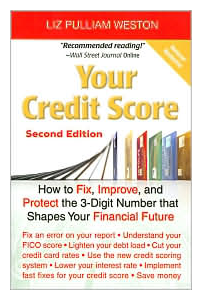
Review: Your Credit Score by Liz Pulliam Weston

08/17/2008

I am a huge fan of Liz Pulliam Weston, so when I came across her book, “Your Credit Score: How to Fix, Improve, and Protect the 3-Digit Number that Shapes Your Financial Future” I had to it.

We spend so much time talking about how to build your credit score here at Ask Mr. Credit Card, and I’ve done so much research on the subject, that I wondered, “Will I actually be able to learn anything new from this book?” As it turns out, I did learn a few things, and I’d love to share them with you.

Why Your Credit Score Matters:

The most fascinating information by far in this chapter was a side-by-side comparison of two different credit score scenarios:

In the first example, the woman had a 750 credit score, while the second woman had a 650 credit score. The example tracked them throughout their lives and noted their interest rates each time they got a loan.

Even though this was a fictional example that showed the women getting loans at the same time, and in the same amounts, the woman with the lower credit score ended up paying $320,000 more in interest over the course of her lifetime. Got that number? $320,000. There’s your retirement money, right there! What would you do to avoid paying nearly a third of a million dollars in interest?

Now, obviously the specifics of this scenario do not apply to everyone, but seeing it spelled out really drove the point home – Over time having a lower credit score will force you to pay far more each time you borrow money, whether it is for your house, your car, or your credit cards.

How Credit Scoring Works:

I had no idea that there were more than one hundred different credit scoring systems out there today, and they are nearly all being sold to consumers, or used by lenders.

Liz does a good job of going over the basics that make up your score (no matter which system you use). They are:

Also discussed is the Vantage Credit Scoring System. This is the credit score model that is embraced by the three credit bureaus, TransUnion, Equifax and Experian. Vantage Score is a little stricter than FICO, and if lenders ever do pick it up there may be quite a few people who find themselves suddenly unable to get credit! However for now, lenders don’t seem to be in a rush to ditch FICO, so if you are going to purchase your credit score, it is probably best to just pay FICO to see it, rather than the three credit bureaus.

Improving Your Credit Score the Right Way:

All the basic advice is here, and clearly explained:

Now all of these things we have covered here at Ask Mr Credit Card, in detail. However, the was one revolutionary bit of advice that made me want to stand up and cheer:

When you focus on paying down your credit card debt, pay down the card with the balance closest to the limit first, and not the card with the highest interest rate.

Now, does this make sense financially? Well, that depends. Normally you would want to pay down the card with the highest interest rate first, to avoid paying the additional interest. However, when you put your credit score above your bottom line, this makes perfect sense.

You might be saying “No, that doesn’t make any sense – why would I want to pay more in interest just to raise my credit score?” Well it goes back to the example from chapter one. Yes, you might pay more in interest for a couple of years until you get your cards paid off – but over the course of your lifetime, you will pay far less than you would if you had not put raising your credit score first.

It really falls under the umbrella of the old Credit vs. Finances debate, and think it’s a pretty brilliant idea.

Besides, if you get your credit score up quickly, then you can always balance transfer cards that have high interest rates, and you will still be better off than you were before.

Credit Scoring Myths:

Liz highlights the ten most common credit score myths, but I want to focus in on just one here:

The myth that you have to carry a revolving balance to raise your credit score.

When I worked for the now-defunct Providian financial, I worked in their collections department. I was instructed to tell people that the correct way to raise their credit score was to carry a balance on their card, and pay the interest every month. At the time, I believed it – now I know better.

Your credit score sees no distinction between carrying a balance on your credit card and paying it off month to month. What gets reported is the amount you charge each month and how close to the limit you are, not the amount you pay down. This is why you should never charge more than 30 percent of your available balance, even if you plan to pay the balance in full the same month.

Rebuilding Your Score After A Credit Disaster:

There is a wealth of information in this chapter. The most important points deal with your rights as a consumer, and Liz Pulliam-Weston goes into great detail on the following topics:

Keeping Your Credit Score Healthy:

This chapter focused not only on good credit practices, but on good personal finance practices as well.

The tips included things like not ing more house than you can afford, having an emergency fund, carrying enough insurance, and keeping your fixed expenses as low as possible. All in all this chapter was not particularly revolutionary, but then, good sound financial advice rarely is.

Many of us roll our eyes when we hear things like “Work hard, keep your expenses low, and pay your bills on time” yet we transfer our money from savings account to savings account just to gain a point or two on our interest rates.

The truth is, if we would follow that time tested advice more often, instead of looking for the magic pill to make our finances better, Liz wouldn’t need to write a book on the subject, and I would probably be out of a job!

Would you recommend this book?

Yes. 100% Yes. I will keep it, and refer to it often as I rebuild my own credit score. There are lessons in this book that are relevant no matter what your financial situation is, but it is an especially good book for anyone who is in the process of paying down their debts, and re-building their credit score. I highly recommend it.

What about you? Have you read this book? Did you like it?

What is your favorite personal finance book? Leave us a comment below!

You can get our future articles on rebuilding your credit score for free when you click here.

Keep Reading:

Additional images © Sunnyvale Real Estate Blog, SEO Copywriting.com, Army.mil.

Privacy Policy Terms and Conditions About Me Disclosure Contact Me

Newsletter Sign Up

Name

Email