Editor's ChoiceCategories Credit Type Issuers Blog

Credit Card Benefits

10/27/2008

Although not technically a reward, credit cards offer many benefits that don’t accrue with each purchase, they come standard. Here are some examples.

Museums For Free

Bank of America has a great program called Museums on Us where one weekend a month you can use your card to get into a museum for free. For example, great museums such as the Metropolitan Museum of Art in New York and the Philadelphia Museum of Art will be free this weekend, November 1st and 2d. The complete list is available at their web site, although sadly it does not include any of the great museums near my home in Denver.

Rental Car Insurance

A credit card is pretty much required to rent a car, however if you could rent without one, you would be crazy. Almost all credit cards offer some sort of car rental insurance, although American Express tends to have the best. The real benefit is that you can decline the rental companies aggressively pitched and over priced insurance. The problem with the insurance you get from your credit card is that it is filled with exclusions. Pickup trucks, SUV’s, sports cars, and almost anything other than a Ford Taurus may be excluded in the fine print. Most policies exclude “off road” driving, even when you are on a dirt or gravel road. Furthermore, many countries are excluded. I am not talking about renting a car in Baghdad Iraq or Kabul Afghanistan, but seemingly safe business and leisure destinations such as Ireland and Mexico are often excluded. Again check the fine print.

After my last trip overseas, I received a $500 charge on my credit card from my rental company several weeks after I had returned. The rental car company had claimed that I damaged a motorcycle in a hotel garage. Only then did I remember that I had in fact accidentally backed into an old, beat up motorcycle in a dark hotel parking garage. I had picked up the bike, and examined it for damage. Their was no visible damage to either my vehicle or the bike, so I did not think anything of it. Apparently, someone had witnessed it and took down the license plate of my rental. Thankfully, American Express stood by me, and I was never held responsible for any “damages” to the bike, real or otherwise.

Chargebacks

This is my favorite benefit, yet I almost never use it. If I order a product, and I don’t receive it, I can always threaten to chargeback. I once was charged a surprise ticketing fee when using a voucher from United airlines. They had never told me of the charge, yet my credit card statement showed a “ticket by mail” fee. They refused to return my money, offering me only more vouchers. When I threatened to charge back the fee to my credit card, only then did they then send me a check. I also used this against Airtran when I did not receive my paid seat upgrade after my flight was canceled. I refused their voucher’s and told them I would charge back the upgrade fee for services not received. I had a credit added to my account the next day.

More often, chargebacks are used when a merchant goes out of business. When my previous telephone provider, Sunrocket, failed I easily recieved my money back. Airline tickets are routinely refunded by credit card companies when the airline goes out of business. People who paid by cash, check, or debit card rarely receive adequate compensation in bankruptcy court.

Airline Lounge Access

Frequent travelers appreciate the benefits of business lounge access. Such perks include internet service, showers, priority customer service desks, food, and most importantly, peace and quiet. Lounge access is free for holders of First and Business class tickets, and airlines sell lounge access passes for several hundred dollars a year. Fortunately, some credit cards offer lounge access as a benefit. Check out cards such as Citibank Platinum Amex, American Express Platinum, the American Express Delta Reserve card, and even the Saks World Elite Mastercard.

Travel Services

Many cards offer travel services such as lost card replacement, traveler’s checks, and reservations. Some people even book their entire vacations through their credit card company. American Express has always been the leader in travel services, although the other major companies have some worthwile offerings you might not be aware of.

Greatest Secrets Of The Coupon Mom

10/26/2008

Coupons give me panic attacks. They seriously do. Just the thought of taking a cart full of groceries, and a fist full of coupons up to the cash register makes me ill. The checkout lane suddenly becomes a battleground. Fighting tooth and nail with a distraught, overworked cashier just to save 30 ¢ off my box of Capn’ Crunch makes me want to pull my hair out and run screaming in the other direction.

Nevertheless, I like my money, and I have no desire to spend more of it than I have to. After all, I don’t want to make Proctor and Gamble rich, I want to make my family rich!

So the idea of learning to use coupons correctly has been “sharking” me for a while. (Do you know what “sharking” is? It’s when you get an idea into your head that you’re not quite comfortable with. You really wish the idea would go away, but there it is…swimming around in your brain, circling you, accompanied by scary music… until you just know it’s going to pounce on you and rip you to shreds.)

Well, that’s me and coupons. I know I can save my family money by using them. I know that it really shouldn’t be all that difficult either. I also know that the amount of money I’ll save might actually make it worth my time.

So, in an effort to believe that coupons are not, in fact, intended for use in psychological warfare, I sat down and read the “Greatest Secrets of The Coupon Mom” by Stephanie Nelson.

There were some really good, and really bad parts to this book. As far as the really bad parts, there were two.

Mary had 7 apples. She split three apples in half and gave two apples plus one half of an apple to John. Then Mary gave 3 half-apples to Margret and one more apple to Sam. How many apples did Mary have left?

No, that’s not real example from the book, (thankfully). But the books example’s were all like that: Just this side of being immediately understandable. You can figure them out, with a little thought and patience. Just like I know I can figure this whole coupon thing out, with a little thought and patience.

So, that’s the bad stuff. Let’s talk about what the Coupon Mom did right!

The thing that I liked most about this book wasn’t that it made me any more comfortable with coupons (because it didn’t). No, the thing I liked most is that she spends the entire last half of the book talking about how you can food for pennies and donate it to a local food bank – to help out in your own community.

As it turns out, The Coupon Mom.com (her website) is completely free to use. She has created a charity called Cut Out Hunger where she’s taken the food bank donations to a whole new level.

So, I have to admit, the thought of cutting as much as 50% off my own grocery bill, and being able to give to charity at the same time – without paying for her service – well, it sounded too good to be true.

I’ll just see about this!” I thought. And like a good little lemming, I went to check out her website. I just wanted to see if she was the “real deal” or if there was some sneaky back door subscription service she was trying to wrangle me into.

And there it is – the front page of her site. Hey! She’s been on Oprah! She must be legit!

Uh-oh. I have to sign up to get to see any of the “deals” in my area. Ok. I signed up, and immediately had to click through three affiliate offers. Right now though, I am still giving her the benefit of the doubt. She does say in the book that they way she keeps her website service free is by placing ads on her site. So…let’s press on.

Hey a free E-book that tells me how to cut my grocery bill in half. That’s a nice bonus right off the bat! I’ll have to save that one for another review, but it’s a nice freebie!

So, let’s get down to the nitty-gritty here. What exactly is the service that the Coupon Mom offers? And is it really free?

What’s the deal?

Well, with two quick clicks of my mouse, I got a list of every item that is on sale right now at the Kroger stores in Nashville, TN. The list also specified any coupons I was supposed to use along with the sale price in order to get the best deal. Pretty cool! And it was actually free.

Unfortunately, there was a tiny problem:

I live in Louisville, Ky, not Nashville TN. My city and state did not return any “deals” for me to look at. (Meaning that they have not yet been added to her database. ) There are a lot of places represented though – you may want to check to see if yours is.

The nice thing about having a list of what’s on sale is that it lets you make out your shopping list and prepare your coupons before you go to the store. Since you already know what’s on sale (including the “unadvertised specials”) you can plan to combine coupons with sales so that you save more money in less time.

So, eh, really cool feature! Wish I could use it. The good news is, that’s only half of the free service she offers.

The second part of the service:

The second half of The Coupon Mom’s free service is a real winner in my book! It’s a searchable coupon database! Basically this means that when I get my Sunday paper, I pull the coupons out, but I do not cut them out. Instead, I write the date on the front, and put the whole thing into a file.

Then, when I make out my grocery list, I go to her site, log in, and search the coupon database.

Let’s say I wanted to popcorn:

I would search “popcorn” in the database. I would then be shown a quick list of every popcorn coupon available in my area – the same coupons that arrived in my Sunday paper. If I see a coupon I like, I go back to my folder, pull out that circular, and only clip out the popcorn coupon!

Yup, I’m sold on that one. No more time wasted cutting out hundreds of coupons that I might never use? I can just take two seconds to search a database, grab the coupons out of my file, and only cut out what I really need right then. Yes! That I’m sold on. And I don’t even have to pay for it!

So, to finish up the review…would I recommend this book? Sadly, no. But I wholeheartedly recommend the website! And I am excited to check out that free E-Book. Even being a coupon novice I don’t really feel like I learned all that much from this book. The features I mentioned above; references to money savings sites, and a list of questions to take to the grocery store to clarify their policy, those I will use.

I will also definitely consider donating to a food bank with some of the money that I save, if I ever get over my fear of using coupons!

All in all, “Greatest Secrets of the Coupon Mom” was a quick inspiring little read. Just not one I would pay for again if I lost it…

For those who do want the free information and access to the sale and coupon databases, you can visit the Coupon Mom homepage. The website definitely will not disappoint you.

And for those of you who excelled on your aptitude tests….how many apples did Mary have left? Leave me a comment below!

My Strategy For My Next Big Reward

10/24/2008

On Wednesday, I shared the story of our last big reward redemption, and promised an update on our future plans. My wife and I had traveled business class to the middle east with our infant. Our two seats on Lufthansa, Swiss, and United were worth over $10,000 and we were able to redeem 230,000 United Mileage Plus miles for them. The value we received was about 4.3 cents per mile, which I consider to be very respectable.

Already Time To Start Planning The Next Trip

After we returned in May, the price of oil began to soar over the summer, and airlines began implementing draconian increases reward redemption costs. I realized that it would be even harder to visit the family next time, especially as our daughter would require her own ticket after her second birthday. I also recalled how little availability their was soon after the flights are in the system, eleven months out. To maximize our chances, we would have to book the reward eleven months before our trip. That means that would already have to start planning strategy to earn enough miles on the right cards now, if we hoped to repeat the trip two years after we returned.

Here Is Our (Current) Thinking

Again, I am sharing my strategy with you not because you might also need three business class tickets to the same region, but because our thought process will illuminate strategies that you might use to leverage reward cards for a big trip. First, we loved our flights on Lufthansa on our last trip, but became completely opposed to ever dealing with United Airlines again. I could write a book on how poorly we were treated, but suffice it to say, we don’t want to chance dealing with them again. While there are no nonstop flights from Denver to our destination, our second goal is to confine the number of flights to two, with a single connection. That narrowed us down to flights on Lufthansa, Air Canada, British Airways, Continental, and Delta.

Almost Infinite Permutations

My favorite credit card, the Starwood Preferred Guest Amex, offers transfers of points to all of those programs and many of their partners. I spent the time to look through all of the airline awards for the five carriers that service this route, and all of their partners. What I discovered was that the miles required for both economy and business class rewards varied greatly. On one hand, All Nippon Airways, a Starwood Partner, would let me redeem a mere 60,000 points for economy, and a mere 90,000 for business on Star Alliance partners Air Canada and Lufthansa, by far the best deal going. The even have a tool that you can use to search partner reward seat inventory. Unfortunately, after a few minutes looking at sample itineraries, it looked like there were very few award seats available through their program. Furthermore, ANA being a foreign airline, they did not offer their own reward credit card. I would be forced to accumulate miles solely through my Starwood Amex, and I didn’t see a way to get nearly enough miles that way. Continental was also going to be hard, as their Starwood point to EasyPass redemption rate was a poor 2:1. Lufthansa had an astronomical number of miles required for their plan’s reward. I also ruled out British, because we would have to go through Heathrow, with a severe baggage loss rate and virtually no carry ons allowed.

Think Domestic

My excitement and disappointment with the ANA route got me thinking that I needed to exclude foreign frequent flier programs as there was no possibility of accumulating miles through an affiliated reward card. I then came across the Hawaiian Airlines program, which is an affiliate of Delta’s. Their Delta award in economy class to the middle east is 80,000 miles, however their business class award is 160,000 miles. They do offer 20,000 bonus points for their Bank of America credit card, and they allow family members to combine miles. It shouldn’t be too hard for my wife and I to each get their credit card, share the miles, and then add more points to our Hawaiian accounts through our Starwood Amex.

Split Cabins

Other than the big comfy chair, we really enjoyed having business class tickets on our last trip for several reasons not directly related to the flight. We were able to cut the lines for security and check in several times, saving us hours of standing around with an infant. We also had lounge access as well as a huge baggage allowance which we foolishly took advantage of. Since three economy class award tickets might be out of our reach, and three business class tickets is just a fantasy, I came up with the idea to just get one business class seat, and two in economy. This way, we should be able to all go through check in and security in the business class line, have lounge access, and a larger checked baggage allowance. Our child will never notice the difference in business, and my wife agreed that she is better able to tolerate economy class than I am, especially next to our two year old daughter’s half empty seat.

Choose An Off Peak Time Of Year

Since we aren’t taking this trip for the weather, we will try to go over winter this time. Hopefully, we won’t have as much difficulty finding seats in the winter as we did last summer.

A Plan Comes Together

Our current plan is to get the sign up bonus on the Hawaiian Bank of America cards, and use our Starwood Amex points to top off the account. Hopefully, we will then have enough Hawaiian points for two economy class tickets on Delta. Then, I will purchase a single economy ticket on the same flight, and use Delta miles to upgrade it to their Business/First class. The upgrade award is only 50,000 Delta miles for the round trip, and frankly, it is a bargain. The price differential between economy and business is at least $2,000, usually more. The best part is, Delta has announced an incredible new lie flat seat that should be installed in their aircraft by the time of our flight next winter. In my opinion, this seat is comparable to many first class seats, and even has little bench opposite the seat that another person can sit in. Perhaps my wife and daughter will be able to join me for meals or something.

Still More Research

If you take away any lessons from this story, it is that lots of research is necessary before planning for your reward. I still need to find out to what extent the Hawaiian airlines reward on Delta is actually available. I also need to find out what the fees would be for the awards. I might also consider just getting the reward directly from Delta, as their lowest mileage award might actually be available in the winter. This is hard work, but if the three of us can have a comfortable trip across the world for $2,000 or so, it will certainly be worth the effort.

Teaching Your Kids About Credit and Money

There are so many important jobs when you are a parent! So many important things that you want your child to know before they grow up and leave your home. How to manage their money and their credit is certainly one of them, but it’s an area that a lot of parents never really go into detail about with their child.

At what age do you start teaching them about credit? When do you talk to them about money? The answer, at least for me, is from the time they are born! Even children as young as two or three can understand basic money concepts.

Here are some quick and simple ways to teach young kids about money and credit:

1) Go shopping with them, and talk to them the entire time. If your child is old enough to count, why not tell them you need a can of tomatoes, and have them price compare? Which can is cheaper? Do you like one brand better than another? What about the packaging?

This can prompt an excellent discussion on frugality – Is the more expensive brand always better?

2) Let your child pay – If you are using cash, hand it to them and supervise them while they count it out. If the store isn’t extremely busy, most cashiers do not mind. If you are using a debit, or credit card, hand it to them, and tell them what it is.

Here sweetie, this is a debit card. When you pay with this card it means that it comes out of my checking account, and it uses the money that I earned at my job.

Or, if it’s a credit card:

This is a credit card. It’s a small loan. When you use it you are borrowing money from the bank, and if you don’t pay the bank off within a month they charge you more!”

I tell my toddler which cards I am using all the time. And yes, I get some strange looks when I hold the card up and say “This is a Debit Card! It’s better than a credit card because I’m using my own money!“. But I will keep saying it until my daughter understands. When she’s old enough to say,

Yes Mom, I know what a debit card is” I *might* stop telling her.

3) Let your child see you pay the bills –
Now obviously, if you’re stressed and pulling your hair out, it might not be the best time to set an example – we all have those months! But if you can find a time when you are calm, go ahead and pay the bills in front of your child. I’m not saying that you have to divulge your entire financial picture to your baby! Just let them see paying bills as a normal part of life.

4) If you carry a balance on your credit cards, show your child how much interest you are being charged, and show them where it is on the statement.

“Look, see, I only paid part of my credit card bill last month, so this month the bank charged me $50 in interest!”

Or:

“You know, if I had put that money into a savings account instead, then the bank would have paid me interest. A savings account is like loaning the bank your money for a little bit, and they pay you money each month because they borrowed it.”

5) Open an investment account for your child, and let them help you run it – Very young children can still be taught good investment principles! We bought our daughter a small amount of Disney stock in her account. We did this not because we believed it was the best investment, but because it was an investment in her. She may not understand what an ETF is yet, but she will know all about Disney. We will help her to understand that those few shares give her a tiny bit of ownership in the company, and it will be a launching pad for more discussions when she’s older.

6) Don’t be afraid to talk to your kids about investing, credit and money – They are not going to learn about it in school. If they don’t learn about these things with you, they are very likely to get their education from the school of hard knocks.

I think a lot of parents avoid talking about these topics because they are afraid they will give their child bad information. You really shouldn’t worry about this. If you tell them something that is wrong, just go back and correct it later. When it comes right down to it, it’s probably better for them to have spotty financial knowledge than none at all. They will fill in the gaps with their own experience as they grow.

7) Tell them where their money should go, do not give them an option –
From a young age, as young as you feel you can manage it, split any money your child gets into categories: Spend, Save, Invest, Charity. Go back to that formula every single time your child gets any amount of money.

I mean really, consistency is key. Most children never grasp an idea the first time. Especially if it’s not an idea they like! They do have to be gently told, over and over, and over and over. If you stick to your guns on this one you are giving them a lifelong habit of success.

8) Talk to your child about what a credit report is – You don’t have to go into the whole concept if they’re young. A simple:

“It’s like a report card. Every dollar I spend on credit is recorded there, and every time I pay my bill it’s recorded there too! If I do a bad job, I get a low score, and then no one will want to let me borrow money any more – that’s like being in detention…for a long time…It takes a long time to get an “A” again if I mess it up”

However you choose to talk to your child about their finances and their credit, the important thing is that you do talk to them.

There are tons of simple ways to teach money and credit quickly, and effectively – I’m sure you can think of a ton of them! Just remember that you probably don’t have to push the good advice at them, just make it a normal part of their lives, and they will thank you for it when they are older.

How do you teach your kids about money and credit? Please leave us a comment below!

Keep Reading:

Best Reward Cards For Recently Rebuilt Credit

10/23/2008

A reader asks:

Ok, what credit score should you have before you start applying for reward cards?

and also, What is a good “starter” reward card for someone who has just recently rebuilt their credit?

Thanks!
Jenna

First, thanks for the great question. Second, congratulations on rebuilding your credit! It is your hard work that has earned you the chance to earn an reward.

When To Apply?

As for what credit score you should shoot for before you start applying for reward cards, I have a few suggestions rather than a simple number. It can’t be said often enough that a reward cards are only for people who pay off their entire balance, in full, every month, on all of their credit cards. The reason is simple, even a very low interest rate is far higher than the value of the best rewards. Once you are consistently able to pay off all of your interest incurring debts, and you are confident of your ability to do so in the future, only then should you start considering which reward card to apply for. Until you reach that point, your only consideration should be a card with a low interest rate and no annual fee.

What Score Should You Have To Apply?

I personally would consider “good” credit to be somewhere around 650 and up. Guess what? I am not in the position to approve credit cards. If you are sure that you will be paying off the balance in full, on time, every month, then you are free to look for the best reward card. At that point, there is no harm in applying for the best card to meet your needs. The worst thing a credit card company can do is say no. It happens, don’t take it personally, and keep trying hard to improve your credit. To put life in perspective, I would much rather be rejected by a bank than a date!

Of course, you real question mention applying to credit cards (plural). If you are still rebuilding your credit, you should continue focusing on that effort, rather than accumulating rewards. As wonderful as rewards are, the best cards may only give you up to 5% of your spending, frequently less. These days, your credit score is used for not just home and auto loans, but rental applications, insurance rates and even job applications. Adversely affecting any of those applications would catastrophically negate any reward you might receive. My advice would be to stick to one or two reward cards, and watch your credit rise as you pay off the balance every month, on time. Stay away from the advanced strategies of applying to multiple cards in order to earn sign up bonuses until your credit is rock solid.

Which Card Should You Apply To

Since there is no harm in applying, find the card that best meets your needs. Since travel cards take a lot of spending to accumulate a nice reward, I would recommend starting with a cash back card that earns an instant return on every dollar spent. I would also shoot for one with no annual fee. Try the American Express Blue Cash card or the Capitol One No Hassle rewards card. If you do travel frequently for business, pleasure (or to visit family : ), then you might consider starting with a credit card tied to a frequent flier program that you are already a part of.

The most important advice is to stay away from offers for sub-prime credit cards or ones targeted on people with imperfect credit, even if they offer a reward. These cards impose high annual fees, low credit limits, and numerous “gotcha” clauses in the fine print. They may offer some reward, but I would forgo any card with an annual fee unless it had an enourmous sign up bonus.

What To Do When Your Credit Card Company Won’t Cooperate

One of our readers, Renee, had this question:

Mr Credit Card,

We make our payments monthly and have not skipped any, however we have been a few days late. I know that has hurt us. We are in debt up to our eye balls! One of our credit cards Citi offered to lower our APR to 0% for 1 yr to help us get it paid off. The other one BofA would NOT lower our 28% APR because we had been late 2 times within 12 months. Our payment is 888.00, this is insane!! How are we suppose to get it paid off.. I don’t know what to do at this point?? We can’t change that we were 3 or 4 days late and now we have a high interest rate. The account has been closed. Not sure why..they state that we called and close it.. We don’t recall doing that. Do you have any suggestions for us?

Hi Renee, thanks for your question!

I do have a couple of suggestions for you that may help. Since Citi offered to lower your interest rate on that card, (They are normally great to work with from everything that I have seen) I am assuming you’ve got that card squared away.

So let’s take a look at the other card. You have a closed Bank of America account, currently at 28% interest with an $888 payment each month.

The first thing you need to do is to pull your credit reports and scores. I know that is not free, but I believe that you should be able to get an introductory offer from a credit monitoring service that would let you get them all for around $30-$45 dollars. (You can always get your credit reports for free, it’s the scores that cost money.) I recommend starting with Experian since it looks like they are doing a “Free credit report and score” promo right now.

You can also check out our past article “How to Get a Free Copy of Your Credit Report From all Three Credit Bureaus.” if you have any questions about this stage.

Now, once you have your credit reports in hand, look to see whether or not your Bank of America account is reporting the account as “closed by lender” or “closed by consumer”. It does make a difference to future lenders.

If it says closed by lender, that means that they closed the account, not you. If it says closed by consumer, and you did not close the account, then you can always call and argue the point with them – possibly getting them to open the account back up.

The other part of this step is your credit scores. Once you know what your score are, you will be able to decide which of the two options below will be best for you:

1) You can apply for a balance transfer to a new credit card with an interest rate under 28%, and work on paying the card down that way.
You can check out our balance transfer page for reviews on which cards are the best, and which ones you’ll want to skip. We do list the introductory rates, and all the associated fees so that you don’t have to waste your time hunting for it.

You will want to use a balance transfer credit card as your first option IF: Your credit scores are over 700 -720, and you find a card that you feel comfortable with. There is no sense paying 28% interest if you don’t have to!

Now, if your credit scores are 700ish or below, you may want to look at this second option – but be aware that taking the advice below will lower your credit score a bit. It’s one of those situations where what’s smart financially is not what’s best for your credit score. So, that’s the disclaimer. 🙂

2) Go a month past due with Bank of America, and call their collections department.
Collections reps are a whole new species as far as being willing to help you. If you get someone rude, just ask for a manager, or call back to get a different operator.

Now, why do I say go past due and talk to the collections department? Several reasons:

If I were in your shoes right now, this is exactly what I would do, in that order. Check your report and scores, try to balance transfer, and then consider going a couple weeks to a month past due and dealing with the collections department.

I give you this advice because I believe you are a lot more interested in what’s smart for your family financially that what’s going to raise your credit score. In the long run, even if you have a few past due payments, it will be OK. Just keep your future balances low, and avoid being late after that – your score will recover. The important thing right now is just to get you out from under your debt so that you can move on to better things!

I hope this helps, please feel free to come back and tell us how things worked out – I would love to know.

Thanks,
Mr. CC

Have a question for me? Leave a comment below!

Keep Reading:

Utilizing Your Reward Cards For Maximum Return, My Story

10/22/2008

As we know, the highest value per dollar spent is often returned when redeeming your points for business or first class international travel.

Last May, after months of planning, we utilized a grab bag of United Mileage Plus offers to somehow eek out enough miles for United’s business class award to visit my wife’s family on a combination of Lufthansa, Swiss, and (sadly) United.

I would like to give you an idea of how we did it, not because you too might be traveling to the same region with your family, but because I hope our thought process will give you and your travel companions some ideas on how best to utilize your reward cards for maximum return.

Visiting The Family

We planned the trip 10 months in advance which created a few special challenges. Our daughter, who was 9 months old when we traveled, had not even been born when we booked the tickets! Since a ticket is required for international travel with an infant, we were unable to ticket her before she had been born and given a name.

How We Did It

To start off with, my wife an I had a modest amount of United miles from some leisure travel, approximately 20,000 miles each. In January of last year, I had the opportunity to take a short term contract job in Richmond Virginia. I realized that if I played my cards right, I could dramatically increase my miles, but I had little hope of getting to the 115,000 miles each required for the round trip tickets to our destination. We started by getting a pair of Chase Mileage Plus credit cards, each with a 20,000 mile sign up bonus, along with a second card for each other from each account. This also allowed us to vary our spending so that we each had enough miles for our reward. Of course, I then flew United to Richmond.

The project was only for three weeks, but I was able to purchase three round trip tickets on my card at the client’s expense. At that time, United was offering something like a 20,000 bonus miles for flying three round trips over a couple months, in order to compete with Frontier and Southwest in Denver. Next, I made sure to book hotels and rental cars with my Mileage Plus Visa as well as receive credits to my Mileage Plus account from the hotels and rental car companies.

Eating To Win

I also signed up for the Mileage Plus Dining program. Again, I was able to sign up for a promotion that offered 5,000 bonus miles for completing 10 dining awards. Once you move up in their program, you can receive up to 10 miles per dollar spent there. This can add up really quickly when you eat out every day on an expense account.

Since I didn’t really know Richmond Virginia restaurants, the ones featured in the dining program were as good as any other. Actually, it forced me to get our of my client’s neighborhood and try some interesting places. Note that most airline loyalty programs are affiliated with some kind of dining reward program.

It Never Hurts To Ask

When traveling with the airlines, things can go wrong, especially with United. When things things did go wrong, I would contact their customer service, ask to speak with a supervisor, and let them know what happened. Inevitably, they would offer to add 5,000 or 10,000 miles to my account as a gesture of their goodwill.

Exhaust All Of Your Options

Despite our best efforts, we still had not reached our goal. I went through each and every company on United’s Mileage Plus partner list to see if there was some way that we could scrounge a few more miles. I came across a bank that was, at that time, offering miles for opening up checking and savings accounts. Sold. My wife and I promptly deposited the minimum dollar amounts in separate accounts, waited the minimum time, received our miles, and closed our accounts. Somehow, I was not surprised to learn that that particular (FDIC Insured) bank later went out of business. Oh well.

Do A Mileage Run

In the old days, like 2007, a popular way to earn miles was to scoop up discount fares, and make a quick flight almost solely for the purpose of earning miles. When ticket fares were lower, the cost of the discount seat would sometimes even pay for itself in miles received. One day, my wife and I saw round trip tickets to Las Vegas on United advertised for under a hundred dollars. My wife had never been to Vegas, a mere one and a half hour flight from our home in Denver. This represented a major hole in her education! Between that sale and some voucher’s we had received from previous United screwups, we went to Las Vegas and back in one evening for less than the price of a taxi to the airport!

The Early Bird Gets The Worm

By last summer, we had just reached the necessary miles for our award seats. I called United ten months in advance of our trip, only to find very few award seats. Only then did I do the research to realize that award seats are snatched up by the most savvy travelers when they are put into the airline’s system eleven months before the flights. In retrospect, I wish I had put my plan into action early enough to have gotten our reservations the full eleven months early. We got the outbound on Lufthansa vi Frankfuhrt, our preferred carrier due to their incredible reputation for service and punctuality, but were only able to get weird itinerary for our return that took us to Denver via Detroit of all places. Worse, the best they could do is return us home a full 3 days earlier than we had planned. That is quite a curtailment of a two week trip across the world. We took it knowing that changes can be made for free on award tickets, and I hoped the flights we wanted would miraculously open up at a later date.

Keep Trying

A couple months after we initially booked our flights, the strangest thing happened. I looked at our itinerary online, and it had changed. Now, we landed in Detroit, had 25 minutes to clear customs, then went to Chicago, then finally to Denver. Note that I never received any notification of the change from United, I only found out about it by taking it upon myself to view the reservation online.

I called United and showed them how my flight had been changed to an unpublished and unworkable routing, and they were somehow able to free up seats on our preferred date of return. This time, we had a combination of Swiss and United flights for our return. We loved Swiss, but somehow dreaded United managed to screw everything up like clockwork on the way home.

Next Time

All in all, it was a great tip and a fantastic use of reward cards and other offers. A pair of business class tickets on that route would have cost well over $10,000, and we flew it all only for the cost of taxes. Best of all, we did not have to endure a 20 hour journey in economy class with an infant on our laps!

Later, I will share our strategy as we plan our next trip.

Bankruptcy Recovery: Lessons Learned

Bankruptcy helped my husband and I in a number of ways – the most important was that we were suddenly debt-free after struggling for well over two years with our debt. But as much as it helped us, it hurt us too, and there were several hard lessons we had to learn before we could ultimately get our credit and our lives back on track.

1) You know, after you declare bankruptcy it’s hard to get a loan!
We knew that going into our bankruptcy, but what surprised me was that after nearly three years of doing everything I could to rebuild my credit score, there are still some lenders who will not even consider me with a bankruptcy on my credit report.

There were a few shady types, auto lots mostly, who started soliciting us before our bankruptcy was even discharged. Aside from that though, we are pretty much financial pariahs.

And really, that’s as it should be. It makes things tough, but if I were lending money, I wouldn’t lend us money after bankruptcy either – not until our credit scores catch up to a normal rate.

So, realizing this was the case, we built up our emergency fund instead. It sure does make you self reliant when you know there is no creditor in the world who is going to be willing to help you when you need it.

This meant that we had to accept responsibility for our finances, and our futures completely. That was tough for a while, because we didn’t have very good habits prior to our bankruptcy (obviously). It got easier as we went along though. Much easier.

2) No health insurance is not an option – Our bankruptcy was almost completely caused by overdue medical bills. So, after we declared bankruptcy, the first thing we did was to secure a good amount of health, and life insurance. We made that mistake once, and we didn’t want it to happen again.

3) We learned to live within our means – When you have no credit card to just “go out and something” it becomes very easy to start living within your means. In fact it’s the ultimate discipline. It’s either spend the money you have, or don’t, but there’s no “pay it later” option. I can honestly say that is the most valuable thing that came out of our bankruptcy.

4) We realized that we didn’t make enough money to support ourselves –
We had to declare bankruptcy because at the end of the month, we had about $100 over and above our normal bills (rent, utilities, etc.) and we were trying to food and gas with that. Basically just scraping by. There was no room to pay the medical bills too. If we couldn’t pay for the gas to get to work, then we had no hope of ever paying anyone back.

So, after the bankruptcy my husband and I sat down together, and worked out a plan. He went back to school and took a new job, plus another part time job. I kept my full time job, and also took on a part time job.

I worked both jobs for two years until I felt like we were back on our feet, and then I went down to one job.

In retrospect, if we’d had any brains we might have done this before the bankruptcy, and possibly been able to avoid it. Hindsight is 20/20 I guess, and while I do wish we had thought of it then, there is no going back to change it.

I guess it made it easier to work those two jobs when I new that it was giving us a fresh start, instead of going to pay off whichever collection company our debt had been sold to that month. Make of that what you will, but it’s the truth.

5) I learned that repairing our credit wasn’t cheap! – The lower your score is, the more it will cost you to raise it back up. I know, the old adage, “Just pay your bills on time, and your score will go up” Yeah, in ten years when the bankruptcy falls off our report!

We do pay our bills on time, but it has been very expensive to actively raise our score as fast as possible. We have spent money on:

Now, I’m not griping here, I swear! I am thankful for every bit of credit I have been able to get since our bankruptcy. I just didn’t expect it to be quite so expensive just to be approved for credit so that I could “pay my bills on time!”

So for those out there who would think that declaring bankruptcy gets you off scott-free, think again. Yes it erases most debts, but it is also one gigantic barrier to moving forward. And it’s a barrier that only the most persistent people will ever be able to overcome.

It’s taken my husband and I a lot of time, and a lot of education, and a lot of hard work just to build back up from where we were. No one can go back and undo decisions they made in the past, but those past decisions certainly stick with you for a long time in cases like this. The best advice I can give anyone considering bankruptcy as an option is this:

Consider carefully. You can’t undo it onces it’s done. It may wipe out the bills that you owe right now, but it will be a very long time before you are financially solvent and credit worthy if you choose to take this route. If you can pay off your bills in under 5 years, then it will probably be best to just commit and pay them off because with a bankruptcy you never really recover for at least 5-7 years, and possibly as many as ten years.

As always, I love your questions and comments! If you have a question for me (or for Mr. Credit Card who specializes in credit questions) you can leave a comment below!

Keep Reading:

The Carnival of Twenty Something Finances: Money Through The Ages Edition

10/20/2008

Welcome to the Carnival of Twenty Something Finances at AskMrCreditCard.com! If you are new here, please pickup our RSS feed, and check out some of the amazing articles below!

Since the beginning of time human beings have bartered, haggled, gambled, and traded items of value to get what they wanted. I think it’s safe to say that as long as money has been around, we humans have developed a real love / hate relationship with it. Sometimes it serves us, sometimes we serve it. With that in mind, I thought it would be fun to take a look back through the ages.

How did we get where we are today?

Our ancestors of a thousand years ago could scarcely envision a stock market – much less a stock market crash or regular cycles of investing! What steps has humanity taken to bring us to this point?


I’ll show you mine if you’ll show me yours: The Barter System


Prior to 9,000 B.C. all forms of trade were done by bartering. There was no currency, no inflation, no “virtual goods”. Everything was traded at face value, according to what the other person was willing to sacrifice to have it. Today bartering is still a valid and time-tested form of commerce in many countries.

The articles below all encompass that “getting back to basics” feel. Since bartering is the first and last form of trade we have available, these are also my editor’s picks. The end, and the beginning, articles of timeless value.


Animals: The First Standard Currency


Believe it or not cattle, sheep, camels, and other beasts of burden were the first things to be assigned a standard value for trade. Land, possessions, even marriages were bought and sold depending on how many heads of cattle were offered. A little later on, agriculture was added to the mix: bushels of wheat, and occasionally vegetables could also be offered as part of an agreement. This type of trade thrived between 9,000-6,000 B.C.

The articles below all take somewhat complex topics and distill them down to the real “grain of truth”. The bits of wisdom that you can pick up and take away with you – bits of wisdom to help you plant the seeds of your own future and get fair value for it.


She Sells Sea Shells:


In the totally-blow-you-away department, the simple cowrie shell was used as currency from 1200 BC onward. These humble little seashells saw their first use as currency in China, but they have been used as recently as last century in some parts of Africa. Most of us have probably owned a necklace or a bracelet made of these at one point or another. Did you have any idea that people in ages past would have considered something as simple as those necklaces worth a fortune? I know I didn’t!

The articles below all have the element of surprise. A new twist on an old topic; hidden wealth in the internet-ocean of knowledge.


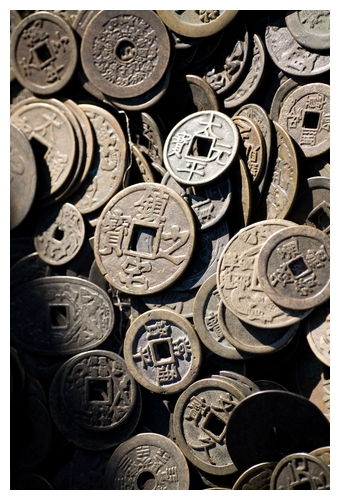
It begins: The first metal coins


The first metal coins were actually cowrie shell reproductions made of bronze or copper.

China began minting them around 1,000 B.C. Over the next 500 years, they gradually evolved into the round “coins” we are familiar with today. These original coins were usually minted with holes in the center so that they could be safely strung together on a chain.

I wonder if this is where the term “chain snatcher” originated? Does anyone know?

The articles below have all taken a simple, natural idea and refined it; minted it into something durable and infinitely usable to suit our purposes today.


“My Precious!”: The first coins made of precious metals, and the early beginnings of the gold standard!


Around 500 B.C. the first coins were minted from lumps of silver, bronze and gold. Lydia (ancient Turkey) Greece, Persia, and eventually the Roman Empire were the first countries to accept this form of currency and make it their standard. These ancient coins were stamped with assorted emperors and gods – probably the first form of trying to prevent counterfeiting!

The articles below are all the “real deal”. They have intrinsic value that goes beyond their time and date stamp. They are minted in the image of their authors, and the knowledge you can gain from them is always a useful currency – measured in more than silver or gold.


We need an easier form of currency! Paper money gets popular:


Paper money was first invented in China around 800 A.D. The Chinese accepted paper as a form of currency for about 500 years, and then it faded into disuse. It wasn’t until about three centuries later that it actually became the most common form of money throughout China and Europe, and it eventually developed into what we recognize as money today.

The articles below all cover some of the more popular financial topics of the day. Like the establishment of paper money, these articles offer fresh and workable ideas which may well spread to become part of tomorrow’s financial foundation.


But What’s a Dollar Really Worth? All Hail The Bank of England!


In 1816 the Bank of England officially made gold the standard that all other values were measured against. They set the official price of gold in order to prevent inflation, and backed their banknotes with a measurable quantity of gold. The United States did the same in 1900.

The articles below are of definite, measurable worth. Many of them are downright innovative; helping to set a new standard for our modern financial difficulties.


*Cough* A Dollar’s Worth What You Say It’s Worth: The End of The Gold Standard

What happened to the gold standard? To put it simply, World War I, The Great Depression, and World War II. It was a one-two-three punch that most countries just couldn’t cope with. It was simply impossible to finance the wars, rebuild everything afterwards, and to recover all the damage to the economy.

The United States officially distanced itself from the gold standard in the 1930’s under Franklin Roosevelt in the hopes of easing the Great Depression.

If Roosevelt took the first steps, it was Richard Nixon that took the last. In 1971 he officially severed the link between our currency and gold reserves by “un-fixing” the price of gold. With the price of gold no longer set, it became impossible to measure the value of our money against the value of gold.

The articles below all deal with the economy, and the changes that our government’s making in an effort to restore it. A whole lot of people disagreed with the government when we moved off of the gold standard, and a whole lot of people disagree with the proposed “economic fixes” we are seeing today. I wonder what history will say about it? Are they right to disagree? Are they wrong? What do you think?

That’s it for the Carnival of Twenty Something Finances! I hope that you have enjoyed reading it as much as I enjoyed putting it together. There were some truly excellent articles featured here, and I want to personally thank everyone for their submissions. I found some new blogs that I had not visited before, and reacquainted myself with a few blogs that were old friends.

I look forward to talking to you all soon. If you like, please feel free to leave a comment below.

Thanks,
Mr. CC

The Complete Guide To Credit Repair

10/19/2008

The Complete Guide to Credit Repair by Bill Kelly, Jr. Is a very thorough, smartly written book with a ton of resources. Among other things it includes:

Much of what is covered in this book we cover regularly on this blog. I had already known, and used, many of the steps outlined in this book, and I can tell you that they do work. Still though, I found a lot of new information that I do believe will help me on my own journey to excellent credit. This book was an wonderful reminder to me of one simple thing: Just because I know a lot about something doesn’t mean that there isn’t a whole lot more to learn!

I think the thing that struck me the most about this book is that it presents your credit report as a “hands on” type of thing. I think most of us just assume that our credit files are locked away somewhere, beyond our reach, and that we can only alter them through a lot of effort and a great force of will. The Complete Guide to Credit Repair has a different approach though.

The author, Bill Kelly, Jr. sees your credit report as something that you own, and must maintain – just like a car. Essentially he’s saying that what is in your credit report belongs to you, not the credit bureaus. It is an accounting of your past history, and it effects nearly every aspect of your lives. So he encourages you to own those reports, take an active hand in what appears there, and gives complete instructions on how to easily update your credit reports.

Bits of Wisdom from “The Complete Guide to Credit Repair”:

Kelly stresses throughout the book that any communication you have with lenders, creditors, or collection agencies should be in writing. This is simple advice, but it’s some of the best advice I’ve ever head with regard to fixing your credit rating.

Many, many people get themselves into trouble when dealing with collection agencies – I did at one point. You make a verbal agreement, and then keep your end of the bargain – only to find that the company goes back on their word and wants to change the terms, or that the rep you spoke with no longer handles your account. If you have things in writing, that does not happen. Kelly also suggests sending everything by certified mail so that you have a record of receipt.

Watch out for scams:

There are thousands of credit repair, credit counseling, and debt consolidation companies out there. Kelly gives a short list of ways to protect yourself from the scam artists so that you can weed out the legitimate companies. Ways to spot a rat include:

What I loved about The Complete Guide to Credit Repair:

The best part of this book for me, by far, was the chapter on how to read your credit report. Kelly covers the reports from each of the three main credit bureaus (Equifax, Experian and Transunion) and gives the most common codes and abbreviations for each report. I can tell you from my own experience trying to repair and correct things on my credit reports, they are not always easy to understand.

Most credit monitoring services do a great job of “dumbing down” the reports and giving you the edited versions. To really repair your credit though, you have to look at the actual reports, not just the summaries. This is where that list of abbreviations and explanations comes in very handy.

Kelly thoroughly covers every code, and clearly spent a great deal of time making sure that you have a complete and usable resource to refer to when you view your own report.

Kelly also offers specific and brilliant ways to deal with your creditors to get them to report things (or not report things) on your credit reports. Sample letters and instructions are included.

This is an awesome book, it really is. If you want to read a more entertaining, “theoretical” approach to credit repair, I recommend Liz Pulliam Weston’s book. But if you want a slightly dry, hands on, how to actually accomplish the nuts and bolts of fixing your credit report guide then you can’t beat this book – you just cant. All the information you need is here, clearly spelled out, in one place.

I bought it for $9.95 at Borders. I’m not sure what the price is at Amazon, but the information in this book is worth far more than that. I found some new techniques to use, and the book is written so well that its actually easy to use. It makes the entire process of understanding and repairing your credit report so simple that I am less intimidated than ever about what I still need to do to fix my own reports. All in all, this is highly recommended – If you truly intend to put the time and effort into updating and correcting your credit reports this is the book you want.

It’s not exactly light reading, I will say that! But it’s informative as it can be, and so full of real, workable letters and tactics that I will be referring to it over and over – I’ll check this book before I check any other when I need answers.

Keep Reading:

Privacy Policy Terms and Conditions About Me Disclosure Contact Me

Newsletter Sign Up

Name

Email