Editor's ChoiceCategories Credit Type Issuers Blog

How to Dispute An Item On Your Credit Report

10/02/2008

I have seen estimates that say as many as 70% of credit reports contain inaccurate or downright false information. Do you know if yours is one of them?

A quick check of your credit report should tell you everything you need to know. It will also help you to catch any instances of identity theft.

If you do not monitor your credit reports regularly, you can still check them once a year for free by going to Annual Credit Report.com.

Any other sites or advertisements that you see do not actually let you check your reports for free. Only Annual Credit Report.com is the real deal.

So, you’ve checked your credit report and found bad information, what then? Let’s take a quick look at the dispute process:

Option One:

You can create an account with all three of the credit bureaus (websites below). All three have entire sections of their sites dedicated to helping you challenge this bad information on your credit report.

Here are the sites you will need to visit:

Once you log in with them, you can begin the automated process of challenging the information on your credit report.

I have actually been through the dispute process with all three of the credit bureaus via their online forms. I can tell you for certain that TransUnion has the best system – because I actually heard back from them after I made the challenges, and they did make the necessary changes. The other two credit bureaus (Equifax and Experian) I heard nothing back. Nada. Zero. Zip. No changes were made.

So, the next option for me was to send in a certified letter to Equifax and Experian. That got results.

Option Two:

Sending in a certified letter:

You will have to spend a little time getting everything together before you send your certified letter in to the credit bureaus.

You will need:

  1. A copy of your most recent credit report from each credit bureau.
  2. Make a copy of your credit report, and highlight any missing or incorrect information.
  3. You will also need to include various forms of identification like a utility bill in your name at your current address, your social security number, and a copy of your driver’s license.
  4. Gather up any supporting documents you will need. Things like canceled checks showing the credit account was paid in full, credit card statements, police reports (in case of identity theft), court documents or discharge papers (in case of a judgment or bankruptcy).
  5. Attach a cover letter to the information stating that you are disputing the highlighted items on your credit report.
  6. Send it certified mail so that you have a delivery receipt.

It’s a lot of trouble to go through, yes, but you could actually raise your credit score considerably just by taking the time to do this.

Your legal rights under the Fair Credit Reporting Act:

Generally when a disputed item is “investigated” it means that the credit bureaus will contact the company or bank that listed the item on your credit report in the first place, and ask them to verify the debt, or status of the debt in question. If the company does not respond to the credit bureau within the thirty day time frame, then the information is removed from your credit report.

It is possible to challenge the same information more than once.

A word of caution: Challenging too many items on your credit report at the same time will cause the credit bureau to freeze your credit report temporarily (until your disputes are settled). If that happens, you will most likely not be able to get a loan during that period of time, because your prospective lenders will not be able to pull your credit report, or your credit score to make a decision on a loan.

People often run into trouble with this because they challenge a bunch of items, and then go apply for a car loan, or a credit card. So, just keep in mind that these disputes are going to tie up your credit report and score for about a month, and don’t apply for anything. If you do, you will not get the loan, and your credit score will drop slightly from the inquiry. Best to wait until everything is resolved, and then move forward with any new loans.

That’s pretty much it. The entire process is really very simple. There is no need, ever, to pay a company to do this for you unless you just really, really do not want to mess with it. Most companies that I have seen charge upwards of $50 a month to challenge items on your credit report for you!

If you want to take care of challenging the bad information on your credit reports yourself, you can click here to download a short, free guide which includes a sample letter of dispute, and the mailing addresses for all three credit bureaus.


Keep Reading:

Make A Statement (On Your Credit Report)

10/01/2008

One of our regular readers, Matt at Steadfast Finances, had this question for us:

Can you recommend a generic type of statement for people who want to close a credit card account just b/c they want it closed, or they think they have too many lines of credit open?

I’m curious if wording exists that could potentially give lenders a psychological moment of pause, or a vote of confidence in favor of the borrower, after reading the 250 word statement.

Thanks for your question Matt!

Matt is referring to the short 250 word statement you can place on any account listed in your credit report. The only time the 250 word statement will matter is if a lender actually views your entire credit report, and not just your credit score.

Times that a lender will typically view your entire credit report include:

In these cases, the 250 word statement might come into play, but the deciding factor will still most likely be your overall credit score.

Now, to answer the question, yes there are right and wrong ways to use your 250 statement. Right ways would include an explanation of why it benefited you to close the account, identity theft, or an explanation of a late payment or complicated account.

The wrong way to use your 250 word statement would be to air grievances with your credit card company or other lender! Prospective lenders really do not want to hear about the time your credit card company processed your payment late, and refused to issue you a credit. They also don’t want to see that you frequently argued with your creditors if they are about to become one of them!

If you have a problem with your bank or credit card company, be sure to take it up with them, or with the Better Business Bureau. Do not attach it to your own credit report – your credit card company will never see it, and it will only make you look bad in the long run.

So, with that said, let’s get down to some specific examples.

For instance, most of us love to take advantage of those “in-store” credit cards, especially around Christmas. So, let’s say you opened up a credit card to take advantage of the 30% to 50% off deal they were having. After Christmas, you paid the card off and closed it. You would want to go back into your credit report, and make a note that says something to this effect:

I opened up this credit account to take advantage of a special discount. When the special offer ended, I paid off the card, and closed it because it no longer benefited me. I have other credit cards with excellent interest rates, and the default interest rate on this one was 24%.

Another good instance would be balance transfer accounts.
You open them to take advantage of the low, or 0% interest for a specific period of time. Your notation could look something like this:

I opened this credit account so that I could take advantage of the 0% interest on balance transfers. Once I paid the balance down, (or the rate expired) I closed the account because of the high annual fee and increased interest rate.

Or, if you are in the process of streamlining your credit accounts – you have too many and don’t want to deal with them all – you could say something like this:

It is my belief that using credit responsibly means having only the number of credit accounts that I can safely and happily manage. I rarely charged anything on this card, and since I have other lines of credit that I prefer to use instead, I closed this account. The cards I kept had better interest rates, and lower fees.

In an identity theft situation, you would want to challenge the item on your credit report as well as make a statement. Hopefully you can have any derogatory information removed permanently. In case of identity theft you can use this notation:

This account is/was in dispute. I had my identity stolen on (date). All or part of the charges made on this card were made by someone other than myself. The late payments that show up are because I had no knowledge of the account (or because I am not obligated to pay for charges I did not make).

If you got ticked off with your credit card company and closed the account, and you absolutely positively must note it on your own credit report, you could put it like this:

The incredibly rude and unhelpful customer service representatives that this company employs made it more worth my while to close this account than to keep it open.

Basically the goal with the 250 word statement is to show a valid reason for closing or disputing an account. In cases like that, the truth is always best.

If you closed the account because you didn’t use the card, say so. If you closed it because the credit card company sold your information to every telemarketer in India (I’m talking to you HSBC Bank – watch out!) then say so.

Always keep in mind though, that what goes on this report is a permanent record. Your permanent record. So choose your words carefully!

Thanks again for your question Matt!

Have a question for us? Leave a comment below!

Keep Reading:

Credit Repair Tricks: Using CD’s and Personal Loans to Raise Your Credit Score

09/30/2008

We get a lot of questions here on Ask Mr Credit Card.com, and there have been some excellent ones on raising your credit score.
Most people want to know both “How can I raise my credit score?” and “How can I raise my credit score as fast as possible?

So I thought we would take a look at some simple tricks that really do help you raise your credit score faster. The first one involves getting a CD at your bank, and then using that CD as collateral for a personal loan. This is completely legal, and it does raise your credit score.

Here are the basics, in case you want to try it for yourself:

Call or visit your local bank online to check their rates on CD’s. You may also want to consider various online banks because they sometimes offer higher rates on CD’s than brick and mortar banks do.

*Warning: If you normally do your banking with a credit union, then you will need to ask a manager whether or not the credit union will report the loan to all three credit bureaus. If they do not, then this strategy will not work for you – find a bank that will report your new loan to the credit bureaus instead.

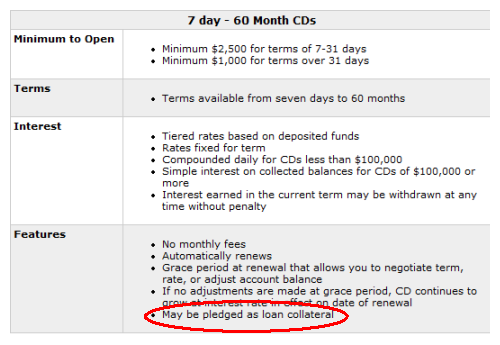
Once you’ve settled on a bank and an interest rate for your CD, read the fine print. Most banks will specify whether or not the CD may be used as collateral for a bank loan. My bank, BB&T has that information on it’s main CD page:

Here’s the quick and simple checklist:

1) Find a bank that you are comfortable with
2) Make sure the bank will report a loan to the credit bureaus
3) Take out a CD
4) Wait about a month – Give the bank time to process the CD, and to get everything in order.
5) Walk into the bank and set up a loan using the CD as collateral.

You can click here to get a printable walk through that covers the entire process step by step.(Microsoft Word File)

Setting up your loan:

Applying for a secured loan (using a CD as collateral) will always get you a better interest rate on the loan than applying for an unsecured personal loan. This is especially important if you have a low credit score. Before you go into the bank to apply for a loan, there are a few things you will need to get together and take with you.

  1. Copies of your pay stubs – make sure that you have at least the last month’s check stubs from your regular job. You may need to take in proof of up to six months of regular paychecks. If your check is directly deposited then print out your last few statements that show a record of the regular deposits.
  2. Work up your monthly budget – You will be expected to prove that you will have the money to repay the loan each month. You will also need to be prepared to list your assets, and liabilities on the loan application.
  3. Put your papers in order – Make sure you have your driver’s license, social security number, and any paperwork relating to your CD with you when you apply for the loan.
  4. Call your bank beforehand – Do a quick check to make sure that your bank will not require you to bring anything else. You want to be as prepared as possible so that you don’t waste a trip, or have your FICO score pulled more than once because you weren’t prepared and had to apply for the loan twice.

What now?

Once you have secured a personal loan by using a CD as collateral, what then? The best thing you can do in this situation is to put the money from the loan into a savings account with the same bank. Do not spend it! Remember that you are just using the loan to raise your credit score, not to finance anything.

Your next step is to set up two auto-drafts to take care of making the payments on the loan. Schedule an automatic withdrawal from your savings account to your checking account, and a separate auto-withdrawal to make the loan payment out of your checking account. Make sure you have at least four days in between drafts so that your bank has time to process everything correctly.

This is very important! I know it’s annoying, and technical, but it puts the entire process on autopilot. You repay the loan, and you never have to think about it again. If you choose not to do this step, then at least mark a calendar each month when the loan payments are due.

What about the interest?

Because you are choosing to take out a secured loan, the interest rate will be lower than with an unsecured loan. You will still have to pay interest on the loan though. The interest that you pay on the personal loan is the cost of raising your credit score quickly.

It is actually cheaper to pay the interest on this loan than to pay the fees and interest on unsecured “bad credit” credit cards, and your credit score does benefit. I can tell you from personal experience that raising your credit score is not cheap. The lower your score is, the more it will cost you to raise it.

*Tip: You can offset some of the interest on the loan by putting the money the bank loans you into a high-interest savings account. That way, you will be earning interest on the money that you borrowed from the bank while you are paying the loan back.

Once the loan has been repaid, be sure to check your credit score. At this point, you can repeat the process and continue raising your score.

One final note:

Once your loan has been repaid you should draw up a letter stating that you made your payments on time, as agreed. Take it into your bank, and have your bank manager sign it. You can then take this letter with you when you apply for an auto loan, a home loan, or even another personal loan. Attach your bank statements to the letter, and highlight the sections that show regular payment on the loan. Keep it in a safe place, and next time you need a loan it will be ready to go!

You can click here for a sample letter that verifies you paid your personal loan on time and in full. (It’s at the bottom – Microsoft Word File)

Have a question for us? Leave a comment below!

Keep Reading:

European Banks Go Under

09/29/2008

I have to apologize for being a little off topic here (away from credit cards). But I think these are unprecedented times and so I’m giving a little update that has caught little attention. Over the weekend, a couple of European Banks have been nationalized.

Firstly, Fortis, the Dutch financial conglomerate has kinda gone under. The governments Belgium, Holland and Luxemberg has injected about $16bn in capital into subsidiaries in each countries, thereby owning 49 percent. Fortis will also sell ABN Amro. With this capital injection, the three governments will own approximately 30% to 40% of the combined entity.

Meanwhile, over at UK, the authorities have nationalized Bradford and Bingley, one of the main building societies in the UK. In a deal hammered with Banco Santander, B&B 21bn (in pounds) deposits will be bought for 600mm!

There are fears about other European Banks like Dexia and Commercebank that have come under pressure from the stock market. It appears that the subprime crisis is speading globally. Guess it can’t be all Bush’s fault in the last eight years? What we are seeing is a classic result of easy global monetary policy which led to the housing bubble. And bad assets on banks books are unravelling right before our eyes.

But watch out. There is more to come.

WAMU Commercials – A Trip Down Memory Lane

Now that Washington Mutual is no longer around, I thought that it would a little comical is we look back at some of their commercials to see how they marketed and branded themselves.

Need Flexible Home Loans? Come to WAMU – Well, isn’t this the loans that got them into trouble? Flexible for consumers, but deadly for WAMU!

WAMU – Free checks for Life! Yeah?

Making Fun of Chinese?

Ripoff.com Video – Ripoffreport.com produced this video about how WAMU could actually give you your free checking account!

Enjoy the commercials. You won’t see this on TV any longer.

Think and Grow Rich

09/28/2008

Every Sunday here at Ask Mr. Credit Card we review a personal finance book. We give you the no-holds-barred lowdown on the top titles so that you can decide whether or not they are worth your hard earned money!

This weekend we’re reviewing a classic: “Think and Grow Rich” by Napoleon Hill. It’s sold over 15 million copies worldwide since it’s original release in 1937.

So what could a 70 year old book possibly have to say that’s worthwhile? Can it really make you rich? Can you actually “think” your way to wealth?

Honestly, I think that if you use the pattern laid out in this book, you can probably “think” your way to nearly anything you want. Whether your goal is wealth, a job, a situation – anything you put your mind to.

This is more of a book on the psychology of the mind than anything financial, but I did love it.

Let’s take a quick look at the different steps that Think and Grow Rich says you should take to achieve the riches you only dream about.

  1. Decide what you want – The mind is like a guided missile, if you don’t give it a direction, it will never reach it’s goal. So the first step in this book is simple: Decide exactly how much money you want. Pick a specific number, write it down, and focus on it every single day.
  2. Have a strong desire for your goal – Get your emotions involved, and visualize yourself achieving it, especially what it will feel like once you’ve reached your goal.
  3. Have faith that you will reach your goal – Suspend your disbelief, and truly believe that your goal is possible for you. It’s harder than you think it will be, but then that’s what the author means by faith. The suspension of disbelief. Keep it in your mind that not only will you have the amount of money you seek, but that it is right, and normal for you to have it. Believe that you will have it.
  4. Decide what you are going to give up to achieve your goal – Think and Grow Rich is very specific on this point. Nothing is free, and nothing is without sacrifice.
    So, by deciding beforehand what you are going to give up, you make a willing sacrifice to move forward.
  5. Draw up a plan of action – It’s hard to get anywhere without a map. Pick specific dates and actions that will help you along the path to wealth. Set road markers. For example, you may want to make a million in the stock market.

    So, you would decide what you would have to learn to get there. You would have to pick specific types of investments, or carefully research a financial advisor. Basically set mini-goals within the larger goal.

  6. Overcome Procrastination – If this one were easier, we’d all be successful! Seriously though, this is one of the most important steps in the entire book. Once you have decided what you want, and drawn up a road map, then the next step is just to start doing it. Regularly. Every day. No matter what.
  7. Rinse, and Repeat until you get there – That’s it.

Parts of the book are frankly full of psychobabble, mumbo jumbo. Some of which I put more stock in than others.

Mostly though, Think and Grow Rich lays out an excellent plan of action for pretty much any goal. The author, Napoleon Hill does believe that by following these steps you unite your conscious and subconscious mind towards one goal. He believes that as long as you continue to do that, you will always achieve your goal.

I think that the book’s title is a tad deceptive “think” and grow rich, well, it all starts with the thinking, but it’s the hard work after the thinking that gets you where you are going.

If you enjoy reading about how to better harness the power of your own mind, and you aren’t put off by the idea that thoughts exist as real physical things (with vibrations and all!) then definitely pick this book up. Run, don’t walk – it’s that good.

If you’re not into all that, then take the recommendations above, and try them out in your own life before ing the book. It’s pretty much the standard plan for success of any sort, and it’s served me (and apparently 15 million others!) very well in the past. Enjoy!

Keep Reading:

Air Travel Reward Cards, The Dark Side

09/27/2008

Reward Cards are fantastic, with millions of users receiving a reward for their purchases that they would not have otherwise received if they were paying with cash or a non-reward credit card.

Overvaluing Airline Rewards

For years you save up for frequent flyer program reward with your reward credit card. When it comes time to redeem the reward for a flight, the airline tells you there are no seats available to your destination, or that you cannot fly on your schedule. Essentially they are only letting you redeem your award for an extremely off-peak itinerary that might not cost that much if you just purchased it with cash. Worse, you are now spending your leisure time on the airline’s schedule, not your own. In the end, you might realize that your reward was not as valuable as you had anticipated when you channeled your spending to that card. Even if the ticket was slightly more valuable than a cash return, perhaps the difference was not worth the aggravation of trying to find an available flight or even rearranging your whole vacation.

Airline Uncertainty

Historically, the airline industry has not been the most stable. For more information, ask the former employees of Pan Am, Eastern Airlines, or one of the dozens that have gone out of business this year alone. Even when airlines remain in business, they are constantly devaluing their loyalty programs by requiring more miles for a reward, and by reducing reward availability. To hedge against this, look for flexible reward card programs such as American Express Membership Rewards or Capitol One No Hassle Rewards. The programs protect you from the devaluation of an airline loyalty program by offering rewards on many different carriers. Finally, never hoard you miles. Airline program points and miles are completely unregulated, and can be devalued almost as fast as the Zimbabwean Dollar. By not using your miles for an available flight you would have paid for, you are taking the risk that the reward, the flight, or even the entire airline will exist at a later date.

Conclusions

What consumers must keep in mind is that rewards always come with some risk. By staying flexible, properly valuing your reward, and seizing availible flights you can minimize your risks, and enjoy airline reward credit cards.

How the WaMu Buyout Will Affect You

We had some excellent reader questions from our article “Washington Mutual Goes Under.” So I thought it would be good to take the time to respond to them, because I think it will clear up a lot of questions that everyone has right now.

KK wondered:

Should we still pay on our credit cards? What will happen if we don’t? Could anyone help me on this?

Yes, KK. Definitely keep paying your credit card bills. If you do not then you can expect to be put into collections and that will ruin your credit score. Excellent question though. Business should continue as usual, and if anything changes you can expect to get a letter from JPMorgan Chase letting you know.

Mary Hull wondered:

My question is are the credit cards issued by WaMu still valid?

Yes, Mary, WaMu cards are still valid. You may eventually be issued a Chase card, but it is more likely that all of the accounts JPMorgan Chase is purchasing will just remain as is. I would say there is a 99% likelyhood that you will start receiving offers from Chase for their credit cards as well.

Thanks also goes to all of our readers that took the time to answer these questions!

If you would like to know more about what’s going on at WaMu, and how it will impact you and your accounts, there are some excellent articles on that topic. I hope that they will put everyone’s fears to rest.

For not, it looks like they only people being screwed by this deal are WaMu’s shareholders. So, with that said, here’s there rest of the dirt:

If you banked with WaMu, borrowed money from them, worked for them, or owned their stock, check out this article from The Digerati Life to see what will happen to you.

Five Cent Nickel’s WaMu Account is still active.

Broke Grad Student has accounts at WaMu – He’s not panicking, and has an article about why you don’t need to panic either.

Thanks also go to the Money Hacks Carnival #31 for featuring our article American Express Black Centurion Card – Value or Ultimate Status Symbol? Moolanomy saved the day by emergency hosting this one!

Keep Reading:

Washington Mutual Goes Under

09/26/2008

Washington Mutual has been taken over by the government in what appears to be the biggest bank failure in history (for now at least). JPM Chase has taken over all of their deposits, which means that no depositors will lost their money at all. They will have the same accounts, the same account numbers and the branches will remain. JPM Chase bought them for their coveted branch locations. However, equity and preferred shareholders are wiped out.

The scary thought is how the mighty have fallen. This isn’t a Wall Street investment banker who was filled with “greed” (according to most conventional wisdom), or where they dabbled in complex derivatives. This is just a savings and loan institution having their mortgages on their books go sour. Yes, they were probably lax in their lending standards as well, but this is an amazing event.

I have to chuckle that just a couple of days ago, a few PF bloggers were promoting WAMU’s deposit rate at 4%. My good friend SVB promoted their 4% high yield savings rate. Nickel actually went a step further and actually opened a WAMU account. He even took screen shots and and went through the process of signing up (well very done). It turns out that last week, my financial advisor called to tell me that WAMU CDs were trading in the secondary market at 10% yield (yes 10%). In fact, the shorter CDs, 1 month and 2 months were at 27% (yes 27%). So if the secondary market for WAMU CDs were at 10%, 4% seems like a ripoff!.

But having said all this, since JPMorgan Chase has bought all their deposits, 4% looks like good value now! Well done Nickel!

Implications – Well, I have a couple of thoughts here. Firstly, it is a great thing that depositors do not lose a single cent. But I think this news is going to spook lots of people. I think there is a real danger of Main Street losing confidence in the banking system.

Many mutual funds also own Washington Mutual, especially value funds. Many funds will be hurt. But the silver lining is that you can tell which fund manager actually knew what he or she was doing.

The banking sector will face even greater consolidation. While consolidation is necessary to take excess lending capacity out of the system, we will be in a situation where banks will get even bigger and more powerful.

For WAMU deposit customers, be prepared to get Chase credit card offers in your mail soon!

American Express Delta Cards, When A Mile Is Not Just A Mile

09/25/2008

American Express offers numerous Delta SkyMiles cards that can be seen in the pockets of most travelers in Atlanta, Cincinnati, Salt Lake City, and other Delta hotspots. What can be confusing is determining which card is for you.

When A Mile Is Not Just A Mile

Frequent Delta Customers know that the key to getting great service is joining the ranks of their SkyMiles Medallion Level. Fees are waived, upgrades obtained, and lines are skipped for all those who have earned exalted status. While Delta SkyMiles can be accumulated with countless promotions, and from a myriad of affiliates, however only a special kind of SkyMile, the Medallion Qualifier Mile, or MQM, will bring you any closer to Medallion status. There are only two ways that you can earn MQMs, flying on Delta, and earning bonuses with the American Express Delta SkyMiles cards.

Earning MQMs With A Reward Card

American Express’s base SkyMiles card, their “Classic” card, and even their “Gold” card offer various mileage bonuses, but no MQMs. Once you move up to their “Platinum” card, only then do the MQMs start rolling in. With your first purchase with the Platinum card, you earn 20,000 SkyMiles, of which 5,000 of them count as MQMs. After that, you earn an additional 10,000 MQMs when you spend $25,000 and again when your spending reaches $50,000 per calendar year. If you were to sign up for this card and spend $50,000 in one year, you would receive a total of 25,000 MQMs, enough to become a Silver Medallion member without even stepping on an airplane! There is a $150 annual fee for this card, but most people will find this well worth it if it allows them to reach a Medallion level they would not have otherwise attained.

The top of the line American Express SkyMiles card is the Delta Reserve Card. With this card, you will recieve 10,000 MQMs with your first purchase, and 15,000 MQMs when your annual spending reaches $30,000 and $60,000 respectively. A business traveler spending $60,000 a year will earn a whopping 40,000 MQMs from their credit card alone, more than half of the 75,000 SkyMiles needed for Platinum Medalion. On the down side, their is a steep $450 annual fee, but there are other benefits that more than justify this fee.

Extra Rewards Beyond SkyMiles

Both the Platinum and Reserve Cards have large annual fees, but it is very easy to justify them with the additional rewards that Delta includes. Both cards offer a free complimentary companion certificate for domestic travel which alone could be worth hundreds of dollars. The Gold card members receive a companion pass for coach travel in the contiguous United States, whereas Reserve card holders receive a certificate good for coach or first class travel to any domestic destination, which is potentially worth well over a thousand dollars. Reserve card holders also receive Delta Crown Room access for yourself and two guests, which is worth the $450 annual fee by itself!

Which Card Should You Get

With rewards going way beyond mere miles, anyone who travels on Delta regularly, if not frequently, should have an Amex Skymiles card. Even if you only travel on Delta few times a year, a Gold Card is almost certainly worth it, if only for the free domestic companion ticket. For all those who travel more than a few times a year on Delta, you should strongly consider the Reserve card. From the lounge access to the companion certificate to the MQMs the Reserve card does the seemingly impossible, it makes the $450 annual fee a bargain.

Privacy Policy Terms and Conditions About Me Disclosure Contact Me

Newsletter Sign Up

Name

Email